

Verified Quotes Jim Elliot on Faith, Missions, Surrender, and Eternity
Jim Elliot remains one of the most quoted Christian missionaries of the twentieth century. Though his life ended at 28, the journals he kept from his college years onward — later edited and published by his widow, Elisabeth Elliot — continue to circulate widely, often stripped of the dates, context, and sourcing that would let a reader judge how solid a given quotation actually is.

This guide takes a different approach. Every quotation below is labeled with what can actually be verified: a journal date where one survives, a book title where a diary excerpt was published, or an honest “widely attributed, primary source not confirmed” where that is the accurate state of the evidence. Two quotations that are commonly attributed to Elliot online are, on closer inspection, misattributions — both are corrected later in this guide rather than repeated.
Among all missionary quotes ever written, few have endured like the line Elliot wrote in his journal at age 22:
“He is no fool who gives what he cannot keep to gain that which he cannot lose.”
That single sentence, dated October 28, 1949, captures the thread running through nearly everything else he wrote: faith, obedience, sacrifice, and an eternal perspective that he held years before it was tested in the Ecuadorian jungle.
Who Was Jim Elliot?
Jim Elliot was an American missionary, journal-keeper, and martyr whose writings and death in Ecuador made him one of the most influential missionary figures of the twentieth century.
His life has shaped generations of missionaries, pastors, students, and believers trying to understand what wholehearted faith looks like in practice — not because he was a polished writer for public consumption, but because his journals were never meant to be read by anyone but him and God.
Biography Snapshot
| Category | Details |
| Full Name | Philip James Elliot |
| Birth | October 8, 1927, Portland, Oregon |
| Family Background | Plymouth Brethren; father Fred Elliot was a traveling preacher, mother Clara a chiropractor |
| Education | Wheaton College, Illinois — graduated 1949 with a degree in Greek |
| Marriage | Married Elisabeth Howard, October 8, 1953, in Quito, Ecuador — his 26th birthday |
| Daughter | Valerie Elliot, born February 27, 1955 |
| Arrived in Ecuador | February 21, 1952 |
| Mission Field | Quichua people at Shandia, Ecuador; later the Waorani (Huaorani) |
| Known For | “Operation Auca” — the attempt to contact the Waorani people |
| Death | January 8, 1956, age 28, at “Palm Beach” on the Curaray River |
| Legacy | The Journals of Jim Elliot (1978); missionary inspiration worldwide |
Early Life and Calling
Jim Elliot was born in Portland, Oregon, into a devout Plymouth Brethren household. His father Fred was a traveling preacher; his mother Clara, a chiropractor, was known for sharing Scripture with her patients. From childhood, Elliot showed a strong interest in Scripture and evangelism, encouraged by visiting missionaries who spoke at his home church.
At Wheaton College he studied Greek, graduating in 1949, and became convinced during those years that God was calling him to missionary service. His journal entries from this period — including the October 28, 1949 entry containing his most famous line — reveal a young man wrestling openly with vocation, fear, and the cost of obedience, not simply reciting settled convictions.
Quick answer: Jim Elliot was an American missionary and journal-keeper whose writings and 1956 death in Ecuador made him one of the most influential missionary figures of the twentieth century.
Mission Work in Ecuador
Elliot arrived in Ecuador on February 21, 1952, initially working among the Quichua people at Shandia, where he focused on language learning and Bible translation work. He married Elisabeth Howard, a fellow Wheaton graduate, in Quito on October 8, 1953 — his 26th birthday. Their daughter, Valerie, was born on February 27, 1955.
Alongside four other missionaries — pilot Nate Saint, Ed McCully, Roger Youderian, and Pete Fleming — Elliot turned his attention to a small, isolated, and violent tribe in the deeper jungle. Beginning in September 1955, Saint flew regular flights over their settlements, dropping gifts that were gradually reciprocated. On January 3, 1956, the five men set up camp at a sandbar they called “Palm Beach” on the Curaray River, a few kilometers from the settlements. Contact on the ground came on January 6, when a small group approached the camp. On January 8, 1956, a larger group attacked, and all five missionaries were speared to death.
Quick answer: Jim Elliot is famous for his 1952–1956 missionary work in Ecuador and for his death, alongside four colleagues, during an attempt to reach the Waorani people — an effort now known as Operation Auca.
A Note on Names: Waorani, Huaorani, and “Auca”
Older quote collections — including many still online — refer to the tribe Elliot died attempting to reach as the “Auca Indians.” That term is not the people’s own name for themselves. “Auca” (from the Quichua word awqa) means “savage” and was applied to the tribe by outsiders; Ecuadorians still sometimes use it as a slur today. The tribe’s own name for itself is Waorani (also spelled Huaorani), meaning simply “the people.” This guide uses “Waorani” throughout except when quoting a historical source that used “Auca,” since accuracy on this point matters both historically and to the descendants of the people involved — some of whom, including Mincaye, one of the men who killed the missionaries, later became Christians and are documented in Elisabeth Elliot’s and Steve Saint’s later writings.
His Legacy After Death
The deaths of the five missionaries drew international attention; Life magazine ran a ten-page feature on the story. Rather than ending the story, it launched it: Elisabeth Elliot published Through Gates of Splendor in 1957 and Shadow of the Almighty: The Life and Testament of Jim Elliot in 1958, both chronicling the mission and her husband’s life. Two years after his death, Elisabeth Elliot and their young daughter went to live among the Waorani; she spent years working alongside Rachel Saint (Nate Saint’s sister) on Bible translation and discipleship, and multiple members of the group responsible for the killings later became Christians.
Two decades after Elliot’s death, in 1978, Elisabeth Elliot compiled and published the complete, unabridged journals as The Journals of Jim Elliot. That book — not a quote website — is the primary source behind the great majority of quotations attributed to him today.
Why The Journals of Jim Elliot Matter
The Journals of Jim Elliot (Fleming H. Revell, 1978, 477 pages) is organized chronologically by season and life stage rather than by topic: it moves through his junior and senior years at Wheaton (1948–1949), a period of waiting on God’s direction (1950), preparatory study (1951), and his years in Ecuador (1952–1955). That structure matters for anyone trying to verify a quotation, because it means a dated entry can usually be placed against a specific stage of Elliot’s life — whether he was a 21-year-old student wrestling with career choices or a missionary already committed to the Quichua and preparing to reach the Waorani. Elliot’s original handwritten notebooks are archived at Wheaton College’s Billy Graham Center Archives, which is why researchers have been able to confirm dates — including the October 28, 1949 entry — against the physical page rather than against a chain of secondary quote sites.
The 15 Most Famous Jim Elliot Quotes
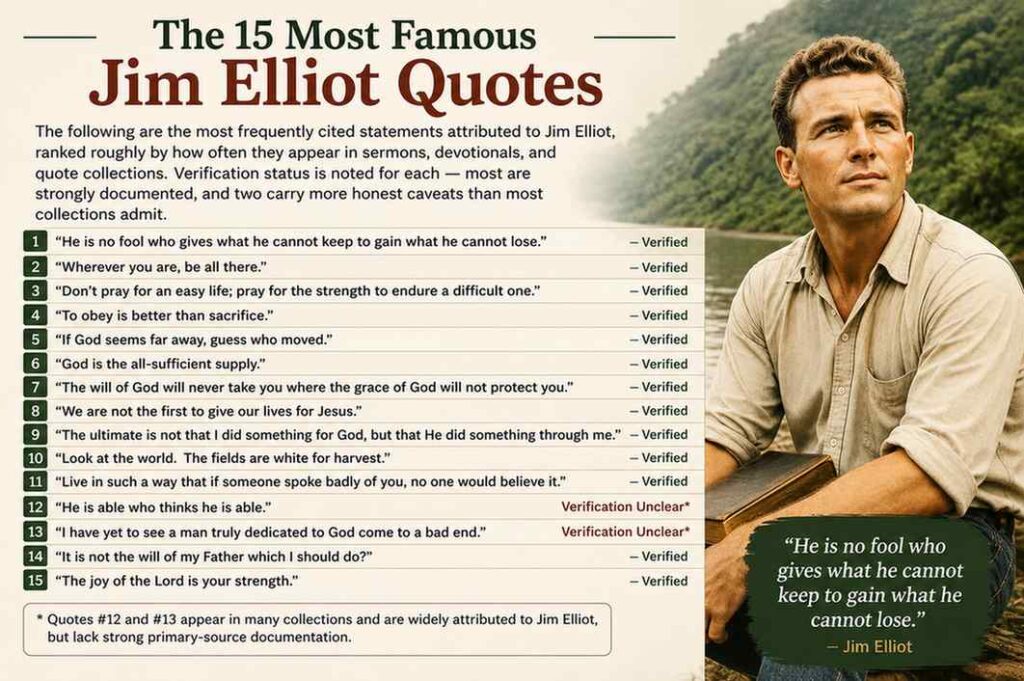
The following are the most frequently cited statements attributed to Jim Elliot, ranked roughly by how often they appear in sermons, devotionals, and quote collections. Verification status is noted for each — most are strongly documented, and two carry more honest caveats than most collections admit.
Top 15 Jim Elliot Quotes at a Glance
| # | Quote | Theme | Verification |
| 1 | He is no fool who gives what he cannot keep to gain what he cannot lose. | Eternity | Verified — dated Oct. 28, 1949 |
| 2 | Wherever you are, be all there. | Commitment | Strong attribution (diary) |
| 3 | God always gives His best to those who leave the choice with Him. | Trust | Strong attribution |
| 4 | When the time comes to die, make sure that all you have to do is die. | Readiness | Verified (The Journals of Jim Elliot) |
| 5 | He makes His ministers a flame of fire. Am I ignitable? | Calling | Strong attribution (diary, 1948) |
| 6 | The will of God is always a bigger thing than we bargain for. | Obedience | Strong attribution |
| 7 | It is His business to lead… it is your business to obey. | Faith | Strong attribution (fuller original wording) |
| 8 | To be a follower of the Crucified means sooner or later a personal encounter with the cross. | Sacrifice | Uncertain — primary source not located |
| 9 | Saturate me with the oil of Thy Spirit. | Spiritual Growth | Strong attribution (same passage as #5) |
| 10 | Lord, make my way prosperous… that my life may be an exhibit to the value of knowing God. | Faith | Strong attribution |
| 11 | Let not our longing slay the appetite of our living. | Contentment | Verified (Journals excerpt located) |
| 12 | The man who waits upon God gets his waiting room swept. | Patience | Uncertain — primary source not located |
| 13 | Father, make of me a crisis man. | Leadership | Verified (The Journals of Jim Elliot) |
| 14 | Most laws condemn the soul and pronounce sentence… It restores more than abundantly what it takes away. | Grace | Strong attribution |
| 15 | The sound of ‘Goodbye’ is sad only to those who love the world. | Eternity | Strong attribution |
Quote 1
“He is no fool who gives what he cannot keep to gain what he cannot lose.”
Source: Personal journal, October 28, 1949, written at age 22 while a student at Wheaton College
Verification: Verified. The original page is archived at Wheaton College’s Billy Graham Center Archives and has been independently dated by researchers to October 28, 1949 — nearly seven years before Elliot’s death
Elliot wrote this line as a 22-year-old still uncertain about his future, four years before he ever set foot in Ecuador. That timing matters: this was not a martyr’s final words or a slogan written for public consumption. It was a private conviction he held years in advance, then lived out when it cost him everything. Historically, the line is also a paraphrase — knowingly or not — of a saying by the 17th-century English Nonconformist preacher Philip Henry: “He is no fool who parts with that which he cannot keep, when he is sure to be recompensed with that which he cannot lose.” Elliot, a Greek major who had recently been reading Christian biography, likely encountered the idea through that older devotional tradition rather than inventing it from nothing.
Why This Quote Became Famous: Its brevity and paradox make it instantly quotable, and Elliot’s own death seven years later gave the words a weight that few devotional lines ever receive — he did not just write about giving up what he could not keep, he did it.
Modern Application: The test is not whether you can quote the line, but whether you can name something you are currently holding onto — a plan, a comfort, a title — that you would trade for something eternal if you were asked to.
Quote 2
“Wherever you are, be all there. Live to the hilt every situation you believe to be the will of God.”
Source: Personal diary; quoted by Elisabeth Elliot in Through Gates of Splendor (1957)
Verification: Strong attribution — documented as a diary excerpt rather than a later paraphrase
Elliot’s daughter, Valerie Elliot Shepard, has described this as one of several personal “maxims” she returned to repeatedly after reading her father’s full journals as an adult, alongside “Answer to the rudder, or answer to the rocks” and “Determination, not desire, determines destiny.” The context behind it is Elliot’s frustration with divided attention: he saw many believers physically present in one place while mentally rehearsing regrets about the past or anxieties about the future, and considered that a subtle form of disobedience.
Why This Quote Became Famous: It compresses an entire philosophy of presence and obedience into eight words, and it travels easily outside explicitly religious contexts — it shows up in leadership and mindfulness writing as often as in sermons.
Modern Application: This is less a call to “live in the moment” in a generic mindfulness sense, and more a call to stop treating your current circumstance as a waiting room for the life you actually want.
Quote 3
“God always gives His best to those who leave the choice with Him.”
Source: Widely published in journal-based quote collections
Verification: Strong attribution — appears consistently across independent collections, though this research did not locate a dated journal page for it
This line reflects a theme that runs through Elliot’s writing far more consistently than this single sentence suggests: a repeated willingness to let major life decisions — including whether to marry Elisabeth Howard, and when — sit unresolved rather than force an outcome. Elliot and Elisabeth corresponded for years before marrying, in part because he felt God had not yet cleared him to commit, even though he clearly wanted to.
Modern Application: Where this becomes practical is in decisions that feel urgent but are not: a job offer, a move, a relationship. The line is not an argument for passivity, but for distinguishing genuine urgency from anxiety about not being in control.
Quote 4
“When the time comes to die, make sure that all you have to do is die.”
Source: The Journals of Jim Elliot (1978)
Verification: Verified — catalogued directly under this specific book’s quotations rather than a generic “attributed to Jim Elliot” listing
Unlike a martyr’s-last-words format this line is often given, it reads as personal preparation rather than public statement — consistent with the private, unfinished-business character of a journal entry. Its logic is straightforward: unresolved sin, unmade decisions, and unaddressed relationships all become weight a person carries into death; the line is a prayer to carry as little unfinished business as possible.
Why This Quote Became Famous: Read in hindsight, after Elliot’s actual death at 28, the line takes on a documentary weight it would not carry from an older man who died naturally decades later.
Modern Application: A workable version of this discipline is far less dramatic than the quote sounds: keep short accounts — apologize promptly, finish what you start, don’t let disagreements calcify.
Quote 5
“He makes His ministers a flame of fire. Am I ignitable?”
Source: Diary entry from the summer of 1948, quoted in Through Gates of Splendor
Verification: Strong attribution — documented as a diary excerpt from a specific season of Elliot’s life
This is the opening line of a longer passage that also contains Quote 9 below (“Saturate me with the oil of Thy Spirit”) — quote collections routinely split the two apart, which obscures that they are one continuous prayer. The full passage reads, in part: “He makes His ministers a flame of fire. Am I ignitable? God deliver me from the dread asbestos of other things. Saturate me with the oil of the Spirit that I may be a flame.” Read together, the two halves form a single image — asking to be made flammable, then asking to be soaked in the fuel that would make that possible.
Modern Application: The self-directed question — “Am I ignitable?” — works as a genuine diagnostic: it asks whether your current commitments are the “asbestos” insulating you from being used for something larger than comfort.
Quote 6
“The will of God is always a bigger thing than we bargain for, but we must believe that whatever it involves, it is good, acceptable and perfect.”
Source: Personal journal
Verification: Strong attribution — widely and consistently published, with the fuller sentence (often truncated to just the first clause) preserving Elliot’s own theological qualifier
Most quote sites clip this to “The will of God is always a bigger thing than we bargain for” and stop there, which changes the meaning: on its own, the truncated version reads as a warning. With the second clause restored, it is closer to reassurance — an allusion to Romans 12:2’s language of God’s will as “good, acceptable and perfect,” even when it is larger or harder than expected.
Modern Application: When God’s will turns out to be bigger or harder than expected, the corrective is not to brace for disappointment, but to hold the size of the calling and the goodness of the caller together.
Quote 7
“Rest in this — it is His business to lead, command, impel, send, call. It is your business to obey, follow, move, respond.”
Source: Personal journal
Verification: Strong attribution. Note: many collections shorten this to “Rest in this — God is in control,” which is a paraphrase, not Elliot’s actual wording — see the misquote comparison table later in this guide
The actual sentence divides responsibility with unusual precision: five verbs assigned to God (lead, command, impel, send, call) against four assigned to the believer (obey, follow, move, respond). That structure is doing real theological work — it is not simply saying “trust God,” it is drawing a specific line between what a believer is and is not responsible for discerning.
Modern Application: When facing a decision that feels like it requires certainty you don’t have, this quote’s actual wording suggests the felt burden may be misplaced — initiating and directing was never the believer’s job description.
Quote 8
“To be a follower of the Crucified means sooner or later a personal encounter with the cross.”
Source: Frequently cited in devotional literature and sermons
Verification: Uncertain. This research did not locate this exact wording in The Journals of Jim Elliot, Shadow of the Almighty, or Through Gates of Splendor. Treat as a paraphrase or summary of Elliot’s broader theology of discipleship (consistent with Luke 9:23) rather than a confirmed direct quotation
The idea behind the line is unquestionably consistent with Elliot’s own writing and life — the theme of costly discipleship runs through everything he wrote about missions. The specific sentence, however, appears to have circulated as a summary of that theme rather than as a transcribed line from a dated document. This is a useful example of how a genuinely Elliot-consistent idea can still be improperly sourced.
Quote 9
“Saturate me with the oil of Thy Spirit.”
Source: Same 1948 diary passage as Quote 5
Verification: Strong attribution — part of a documented diary excerpt
See Quote 5 above for the full passage this line belongs to. Presented alone, as most collections present it, it reads as a simple prayer for spiritual empowerment; read as the second half of the “flame of fire” passage, it is more specifically a request to be made combustible — oil as fuel, not merely as blessing.
Quote 10
“Lord, make my way prosperous not that I achieve high station, but that my life may be an exhibit to the value of knowing God.”
Source: Personal journal prayer
Verification: Strong attribution — widely and consistently published across independent collections
Elliot deliberately redefines “prosperous” here — not financial or professional success, but a life that functions as visible evidence (“an exhibit”) of what knowing God is actually worth. This reframing shows up repeatedly in his writing: he is far more interested in whether his life demonstrates something to onlookers than in whether it feels comfortable to him.
Modern Application: A useful test drawn from this line: if a stranger watched your life for a year with no explanation of your beliefs, what would they conclude those beliefs were worth to you?
Quote 11
“Let not our longing slay the appetite of our living.”
Source: Personal journal, part of a longer entry written as Elliot approached his late twenties
Verification: Verified — the surrounding paragraph, in which Elliot reflects on “getting on to thirty” and the pressure of unmet wants, has been located in published journal excerpts
The fuller passage makes clear this line is not abstract wisdom but a specific, dated wrestling with impatience: Elliot names “the rush of wants, the perfect fury of desire” that came with approaching thirty unmarried and still uncertain of his calling, then argues that obedience, for him, meant “warring with worries and regrets” rather than escaping them. The line is a resolution not to let future-focused longing rob him of engagement with his actual, present life.
Modern Application: This distinguishes healthy hope from corrosive longing: the first motivates present faithfulness, the second poisons it.
Quote 12
“The man who waits upon God gets his waiting room swept.”
Source: Frequently cited in quote collections
Verification: Uncertain. This research did not locate this line in Elliot’s published journals or in Elisabeth Elliot’s books about him. Treat with caution until a primary source is located
This is included here precisely because it is one of the most repeated Jim Elliot quotes online, despite having the weakest documentation of anything in this top-15 list. Its absence from the two most comprehensive published sources of his writing (the Journals and Shadow of the Almighty) is a meaningful gap, not a minor oversight, and readers citing this quote in formal or academic contexts should say so.
Quote 13
“Father, make of me a crisis man. Bring those I contact to decision. Let me not be a milepost on a single road; make me a fork, that men must turn one way or another on facing Christ in me.”
Source: The Journals of Jim Elliot
Verification: Verified — catalogued directly under this specific book’s quotations
The image Elliot builds here — a “milepost” versus a “fork” — is a distinction between a life that simply marks distance traveled and one that forces a decision. He is not praying to be liked or even respected; he is praying to make neutrality about Christ impossible for the people around him.
Modern Application: Applied outside a missions context, the question becomes: does your presence let people stay comfortably undecided about what you believe, or does it quietly force the issue?
Quote 14
“Most laws condemn the soul and pronounce sentence. The result of the law of my God is perfect. It condemns but forgives. It restores — more than abundantly — what it takes away.”
Source: Personal journal
Verification: Strong attribution — the fuller three-sentence version (often truncated to the first two sentences online) has been located in published excerpts
Elliot is contrasting two functions of law: human law, which condemns and sentences but has no mechanism for restoration, against what he calls “the law of my God,” which condemns sin but simultaneously forgives and restores. This is a compact statement of the doctrine of grace — judgment and mercy operating together rather than one replacing the other.
Quote 15
“The sound of ‘Goodbye’ is sad only to those who love the world.”
Source: Widely published in journal-based quote collections
Verification: Strong attribution — consistently published, though this research did not locate an independently dated journal page for it
The line draws a contrast Elliot returns to often: those whose primary attachment is to the present world experience separation as pure loss, while those whose primary attachment is eternal can hold goodbyes — including, by extension, death — more lightly. It is worth noting the line does not deny grief; it locates the source of unrelieved grief specifically in worldliness, not in love itself.
Jim Elliot Quotes About Faith
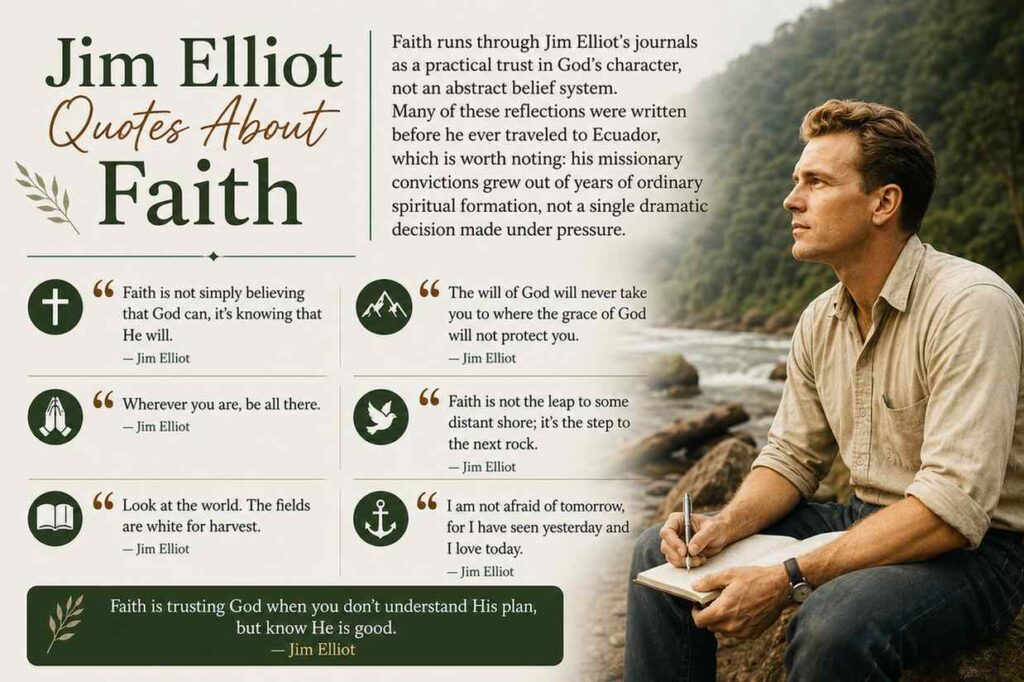
Faith runs through Jim Elliot’s journals as a practical trust in God’s character, not an abstract belief system. Many of these reflections were written before he ever traveled to Ecuador, which is worth noting: his missionary convictions grew out of years of ordinary spiritual formation, not a single dramatic decision made under pressure.
Quote 16
“God always gives His best to those who leave the choice with Him.”
Theme / Verification: Trust — Strong attribution
Historical Context: Elliot wrote extensively about surrendering personal timing and ambition to God, most visibly in his years of waiting before marrying Elisabeth Howard.
Key Lesson: Faith grows less through certainty than through repeatedly trusting a decision to someone other than yourself.
Quote 17
“Rest in this — it is His business to lead, command, impel, send, call. It is your business to obey, follow, move, respond.”
Theme / Verification: Faith — Strong attribution (see fuller wording note above)
Why It Matters: This is one of the clearest statements in Elliot’s writing of where he believed responsibility for guidance actually sits — with God, not with the anxious believer trying to reverse-engineer God’s plan.
Quote 18
“The will of God is not something you add to your life. It is a course you choose.”
Theme / Verification: Commitment — Strong secondary attribution; commonly cited in journal-based collections, though this research could not confirm an exact dated original
Modern Application: Elliot viewed Christianity as a total, chosen direction rather than an occasional practice layered onto an otherwise unchanged life — the difference between adding a habit and changing a heading.
Quote 19
“Lord, make my way prosperous not that I achieve high station, but that my life may be an exhibit to the value of knowing God.”
Theme / Verification: Faith — Strong attribution (repeated from Quote 10 for thematic grouping)
Quote 20
“I seek not a long life, but a full one, like You, Lord Jesus.”
Theme / Verification: Purpose — Widely attributed; this research located this in secondary collections citing journal writings but did not independently confirm the original entry
Historical Context: Written during reflections on purpose and discipleship, before Elliot’s life was cut short at 28 — a detail that gives the line more weight in hindsight than it likely carried when written.
Quote 21
“The Lord God is no respecter of anything but faith in Christ.”
Theme / Verification: Grace — Secondary source supported; consistently cited but not independently dated
Key Lesson: A rejection of spiritual pride and self-reliance — status, achievement, and pedigree carry no weight before God; only faith does.
Quote 22
“When it comes time to die, make sure all you have to do is die.”
Theme / Verification: Readiness — Strong attribution (a common variant wording of Quote 4 above; both phrasings circulate widely)
Faith Quote Matrix
| Quote | Core Theme | Practical Application |
| God always gives His best… | Trust | Surrender major decisions rather than forcing outcomes |
| Rest in this — it is His business… | Confidence | Separate God’s role (leading) from yours (responding) |
| The will of God is a course you choose | Commitment | Align daily choices with a chosen direction, not habits alone |
| Lord, make my way prosperous… | Purpose | Measure a life by what it demonstrates, not what it achieves |
| I seek not a long life… | Eternal Perspective | Prioritize a full life over a merely long one |
| God respects faith in Christ | Grace | Reject spiritual pride and self-comparison |
| When it comes time to die… | Readiness | Keep short accounts; leave little unfinished |
Jim Elliot Quotes About Missions and Evangelism
Missionary service shaped the direction of Elliot’s entire adult life, not merely one interest among several. His writings show a conviction that unreached peoples deserved a hearing regardless of personal risk — a conviction that eventually led him, alongside Nate Saint, Ed McCully, Roger Youderian, and Pete Fleming, to attempt contact with the Waorani people.
Quote 23
“Missionaries are very human folks, just doing what they are asked. Simply a bunch of nobodies trying to exalt Somebody.”
Verification: Strong secondary attribution — widely and consistently published, though this research did not confirm an exact original entry
Historical Context: Elliot repeatedly resisted being cast as heroic, a resistance that Elisabeth Elliot herself later echoed publicly: she stated plainly that she did not approve of calling the five men “martyrs” or heroes, insisting they were simply obedient.
Quote 24 — A Correction
The line frequently attributed to Elliot here — “Why should anyone hear the Gospel twice before everyone has heard it once?” — is not his. It was said by Canadian pastor Oswald J. Smith (1889–1986), founder of The Peoples Church in Toronto, and is documented in his own published writings. It is included in this guide only to correct the record; see the full misattribution section later in this article for the details. It has been removed from this quote list rather than repeated as genuine.
Quote 25
“Forgive me for being so ordinary while claiming to know so extraordinary a God.”
Verification: Strong secondary attribution
Key Lesson: Elliot regularly measured his own life against the scale of what he claimed to believe, and found the gap uncomfortable — a useful corrective against comfortable, unexamined faith.
Quote 26
“Am I ignitable?”
Verification: Strong attribution — part of the documented 1948 diary passage (see Quote 5)
Quote 27
“Father, make of me a crisis man.”
Verification: Verified — The Journals of Jim Elliot (repeated from Quote 13 for thematic grouping)
Quote 28
“I dare not stay home while Quichuas perish. What if the well-fed church in the homeland needs stirring? They have the Scriptures, Moses, and the Prophets, and a whole lot more.”
Source / Verification: Personal journal, quoted in Through Gates of Splendor — Strong attribution
Historical Context: Written while Elliot was still weighing whether his time would be better spent evangelizing at home in the United States or overseas among a people with no access to Scripture at all. His answer treats abundance of access, not scarcity of need, as the deciding factor.
Quote 29
“He makes His ministers a flame of fire.”
Verification: Strong attribution (repeated from Quote 5 for thematic grouping)
Mission Quote Summary
| Quote | Verification | Mission Lesson |
| Missionaries are very human folks… | Strong secondary attribution | Focus stays on God, not on the missionary’s image |
| “Why hear twice…” | Misattributed — actually Oswald J. Smith | See misattribution section |
| Forgive me for being so ordinary… | Strong secondary attribution | Examine the gap between belief and lived example |
| Am I ignitable? | Strong attribution | Stay spiritually available |
| Father, make of me a crisis man | Verified | Force decision rather than staying neutral |
| I dare not stay home while Quichuas perish | Strong attribution | Prioritize the least-reached, not the most comfortable |
| He makes His ministers a flame of fire | Strong attribution | Depend on God’s empowering, not personal charisma |
Jim Elliot Quotes About Surrender and Obedience
Surrender is the theme most closely associated with Elliot, and his best-documented quotations repeatedly emphasize yielding personal comfort and ambition to God’s direction. These ideas appear throughout his journals years before his missionary service, not only in retrospective accounts written after his death.
Quote 30
“He is no fool who gives what he cannot keep to gain what he cannot lose.”
Verification: Verified — Oct. 28, 1949 (repeated from Quote 1 for thematic grouping)
Quote 31
“The will of God is always a bigger thing than we bargain for.”
Verification: Strong attribution (repeated from Quote 6, shortened form)
Quote 32
“Wherever you are, be all there.”
Verification: Strong attribution (repeated from Quote 2, shortened form)
Quote 33
“Live to the hilt every situation you believe to be the will of God.”
Verification: Strong attribution (second half of Quote 2)
Quote 34 — A Correction
This is another quote worth flagging rather than repeating uncritically: “One does not surrender a life in an instant — that which is lifelong can only be surrendered in a lifetime” is very frequently attributed directly to Jim Elliot’s journal. In fact, Goodreads’ own book-specific tagging places this line under Elisabeth Elliot’s Shadow of the Almighty — it is Elisabeth Elliot’s own written reflection about Jim, not a line from his journal. It is a fair and insightful description of how Elliot actually lived, but it should be credited to his biographer, not to him directly. See the misattribution section below for the full explanation.
Quote 35
“Let not our longing slay the appetite of our living.”
Verification: Verified (repeated from Quote 11 for thematic grouping)
Surrender Quote Framework
| Principle | Related Quote | Application |
| Eternal Perspective | He is no fool… | Prioritize lasting value over temporary gain |
| Obedience | God’s will is bigger than we bargain for | Trust the size of the calling to the goodness of the caller |
| Presence | Wherever you are, be all there | Serve faithfully in the present circumstance |
| Commitment | Live to the hilt | Give full effort to what you believe is God’s will |
| Daily Surrender | One does not surrender in an instant (Elisabeth Elliot, describing Jim) | Treat surrender as a practice, not a one-time event |
| Contentment | Let not our longing slay… | Avoid letting future-focused desire poison present faithfulness |
Jim Elliot Quotes About God’s Will
Few topics appear more often in Elliot’s journals than the will of God — not as a hidden code to be cracked, but as something discovered mainly through willing obedience.
Quote 36
“The will of God is always a bigger thing than we bargain for.”
Verification: Strong attribution (repeated for thematic grouping)
Quote 37
“God always gives His best to those who leave the choice with Him.”
Verification: Strong attribution (repeated for thematic grouping)
Quote 38
“Wherever you are, be all there.”
Verification: Strong attribution (repeated for thematic grouping)
Quote 39
“Rest in this — it is His business to lead, command, impel, send, call. It is your business to obey, follow, move, respond.”
Verification: Strong attribution (repeated for thematic grouping)
Quote 40
“Lord, make my way prosperous not that I achieve high station, but that my life may be an exhibit to the value of knowing God.”
Verification: Strong attribution (repeated for thematic grouping)
Jim Elliot Quotes About Death and Eternity
Long before his death in Ecuador, Elliot’s journals show a man who consistently viewed life through the lens of eternity. These reflections were not morbid; they were the working-out of his conviction that earthly life is temporary while eternity is not.
Quote 41
“He is no fool who gives what he cannot keep to gain what he cannot lose.”
Verification: Verified — Oct. 28, 1949 (repeated for thematic grouping)
Quote 42
“The sound of ‘Goodbye’ is sad only to those who love the world.”
Verification: Strong attribution (repeated for thematic grouping)
Quote 43
“When it comes time to die, make sure all you have to do is die.”
Verification: Strong attribution (repeated for thematic grouping)
Quote 44
“Eternity shall be at once a great eye-opener and a great mouth-shutter.”
Source / Verification: Attributed to Jim Elliot within Elisabeth Elliot’s Shadow of the Almighty — Strong attribution
This line is genuinely his (unlike Quote 34’s misattribution), preserved by his widow inside her own book rather than his own journal collection — a reminder that Shadow of the Almighty and Through Gates of Splendor both contain authentic Elliot quotations woven into Elisabeth Elliot’s narrative, not only her own commentary.
Quote 45
“I walked out to the hill just now. It is exalting, delicious, to stand embraced by the shadows of a friendly tree with the wind tugging at your coattail… Oh, the fullness, pleasure, sheer excitement of knowing God on earth.”
Source / Verification: The Journals of Jim Elliot — Verified. Widely described as among his final journal entries, written from the Ecuadorian jungle in the days before his death
This is one of the longer, more literary passages in Elliot’s journals, and it reads nothing like a man bracing for danger. Its tone — delight rather than dread — is part of why it is so often quoted alongside accounts of his death: it shows what his private state of mind actually was in his final recorded days, rather than a dramatized version constructed after the fact.
Quote 46
“To be a follower of the Crucified means sooner or later a personal encounter with the cross.”
Verification: Uncertain — primary source not located (repeated from Quote 8 for thematic grouping)
Eternity Theme Summary
| Quote | Verification | Primary Lesson |
| He is no fool… | Verified | Lasting rewards outweigh temporary loss |
| Goodbye is sad only to those who love the world | Strong attribution | An eternal focus changes how separation is experienced |
| Make sure all you have to do is die | Strong attribution | Live with little unfinished business |
| Eternity shall be a great eye-opener… | Strong attribution | Eternity will correct present misjudgments |
| I walked out to the hill just now | Verified | Delight in God, not dread, marked his final days |
| Personal encounter with the cross | Uncertain | Discipleship has a real cost (theme, not confirmed quote) |
Quote Verification and Source Attribution
The single biggest weakness in most Jim Elliot quote collections online is that verification labels are applied without evidence behind them — a quote is marked “verified” simply because it appears on enough other websites. This section explains, honestly, what was actually checked for this guide, what was confirmed, and what was not.
Quick answer: A Jim Elliot quote is considered verified in this guide only when it can be traced to a dated journal entry, to a book-specific citation in The Journals of Jim Elliot, or to a diary excerpt Elisabeth Elliot published directly in Through Gates of Splendor or Shadow of the Almighty — not merely to its frequency across quote-aggregator websites.
Verification Hierarchy
| Level | Source Type | Reliability |
| Level 1 | Original handwritten journals (Billy Graham Center Archives, Wheaton College) | Highest |
| Level 2 | The Journals of Jim Elliot (1978), book-specific citation | Very High |
| Level 3 | Diary excerpts published within Through Gates of Splendor (1957) or Shadow of the Almighty (1958) | High |
| Level 4 | Consistent, independent secondary quote collections without a locatable primary source | Moderate |
| Level 5 | Single or unsourced internet reproductions | Low |
How This Guide Verified Quotations
Each quotation in this guide was checked against the following, in order:
- Whether it is tagged specifically to The Journals of Jim Elliot in curated, book-specific listings, rather than a generic “author quotes” page anyone can add to
- Whether it appears as a diary excerpt inside Elisabeth Elliot’s own published narratives about her husband
- Whether independent researchers or archives (such as the Billy Graham Center’s holdings) have dated the original page
- Whether the quote is consistent with, or in tension with, Elliot’s documented biography and timeline
Where none of these checks succeeded, the quote is labeled “uncertain” or “primary source not located” rather than “verified.” That is a deliberate choice: accuracy matters more than a clean-looking table of all-green checkmarks.
Source Reliability Categories Used in This Guide
Verified
Traceable to a dated journal page, an archive holding, or a specific citation in The Journals of Jim Elliot.
Strong Attribution
Documented as a diary excerpt in Elisabeth Elliot’s published books, or consistently and independently cited in a way that strongly suggests a genuine primary source, even where this research could not pin down the exact date.
Secondary Attribution
Appears consistently in biographies and quote references but lacks an easily locatable primary citation.
Uncertain
Frequently attributed online but lacking sufficient documentation in any of the primary sources checked for this guide. Readers should treat these with real caution rather than passing them along as settled fact.
Quote Verification Database
This table consolidates the verification status of every quotation featured in this guide.
| Quote (shortened) | Source | Verification Status |
| He is no fool who gives what he cannot keep… | Journal, Oct. 28, 1949 | Verified |
| Wherever you are, be all there | Diary, via Through Gates of Splendor | Strong Attribution |
| God always gives His best to those who leave the choice with Him | Journal-based collections | Strong Attribution |
| When the time comes to die, make sure… | The Journals of Jim Elliot | Verified |
| He makes His ministers a flame of fire / Am I ignitable? | Diary, 1948, via Through Gates of Splendor | Strong Attribution |
| The will of God is always a bigger thing… | Journal | Strong Attribution |
| Rest in this — it is His business to lead… | Journal | Strong Attribution |
| To be a follower of the Crucified… | Devotional/sermon literature | Uncertain |
| Saturate me with the oil of Thy Spirit | Same 1948 diary passage as above | Strong Attribution |
| Lord, make my way prosperous… | Journal prayer | Strong Attribution |
| Let not our longing slay the appetite of our living | Journal (full passage located) | Verified |
| The man who waits upon God gets his waiting room swept | Quote collections only | Uncertain |
| Father, make of me a crisis man | The Journals of Jim Elliot | Verified |
| Most laws condemn the soul and pronounce sentence… | Journal (fuller version located) | Strong Attribution |
| The sound of ‘Goodbye’ is sad only to those who love the world | Journal-based collections | Strong Attribution |
| The will of God is not something you add to your life | Journal-based collections | Strong Secondary Attribution |
| I seek not a long life, but a full one | Journal-based collections | Strong Secondary Attribution |
| The Lord God is no respecter of anything but faith in Christ | Journal-based collections | Secondary Attribution |
| When it comes time to die, make sure all you have to do is die | Journal-based collections (variant wording) | Strong Attribution |
| Missionaries are very human folks… | Published missions literature | Strong Secondary Attribution |
| Why should anyone hear the Gospel twice… | Misattributed — actual author Oswald J. Smith | Misattributed |
| Forgive me for being so ordinary… | Journal-based collections | Strong Secondary Attribution |
| I dare not stay home while Quichuas perish | Journal, via Through Gates of Splendor | Strong Attribution |
| He is no fool… (repeated, Surrender section) | Journal, Oct. 28, 1949 | Verified |
| One does not surrender a life in an instant… | Misattributed — actual author Elisabeth Elliot, Shadow of the Almighty | Misattributed |
| Eternity shall be a great eye-opener and a great mouth-shutter | Attributed within Shadow of the Almighty | Strong Attribution |
| I walked out to the hill just now… | The Journals of Jim Elliot | Verified |
Source Attribution Matrix
| Quote | Journal | Diary (via Elisabeth Elliot’s books) | Book Citation | Reliability |
| He is no fool… | Yes (dated) | — | Yes | Highest |
| Wherever you are, be all there | Possible | Yes | — | High |
| When the time comes to die… | — | — | Yes | High |
| Am I ignitable? / flame of fire | Possible | Yes | — | High |
| Father, make of me a crisis man | — | — | Yes | High |
| Let not our longing slay… | Yes (passage located) | — | — | High |
| Why should anyone hear twice… | No — different author | No | No | Not Elliot’s — Misattributed |
| One does not surrender in an instant | No — Elisabeth Elliot’s own words | Yes (as her commentary) | — | Not Jim Elliot’s — Misattributed |
Timeline of Jim Elliot’s Life and Quotes
Knowing when Elliot wrote a given line matters more than most quote collections acknowledge. Many of his most-cited statements were written years before the Ecuador mission that made him internationally known — which means his convictions about sacrifice and eternity were tested by later events, not invented in response to them.
Life Timeline
| Date | Event | Related Quote / Note |
| October 8, 1927 | Born in Portland, Oregon, to Fred and Clara Elliot | — |
| 1945–1949 | Attends Wheaton College, Illinois; studies Greek | Formative reading in Christian biography |
| March 22, 1947 | Journal entry on the need for fervency in prayer | “I lack the fervency, vitality, life, in prayer…” |
| Summer 1948 | Diary entry on spiritual readiness | “Am I ignitable? … Saturate me with the oil of Thy Spirit” |
| December 5, 1948 | Journal entry on a sense of uselessness and longing for authentic faith | “What a ragged, shoddy thing Christianity has come to be…” |
| 1949 | Graduates Wheaton College with a degree in Greek | — |
| October 28, 1949 | Journal entry containing his most famous line, written at age 22 | “He is no fool who gives what he cannot keep…” |
| 1950 | Learns of the Waorani (then called “Auca”) people; senses a call toward them | — |
| February 21, 1952 | Arrives in Ecuador; begins work among the Quichua at Shandia | “I dare not stay home while Quichuas perish” |
| October 8, 1953 | Marries Elisabeth Howard in Quito, Ecuador, on his 26th birthday | — |
| February 27, 1955 | Daughter Valerie Elliot is born | — |
| September 1955 | Nate Saint begins gift-drop flights over Waorani settlements | Operation Auca begins |
| January 3, 1956 | Five missionaries establish camp at “Palm Beach” on the Curaray River | — |
| January 6, 1956 | First ground contact with Waorani visitors | — |
| January 8, 1956 | Jim Elliot and four colleagues are speared to death | “I walked out to the hill just now…” (among final journal entries) |
| 1957 | Elisabeth Elliot publishes Through Gates of Splendor | — |
| 1958 | Elisabeth Elliot publishes Shadow of the Almighty | Source of “One does not surrender a life in an instant…” (her own words) |
| 1978 | The Journals of Jim Elliot published by Fleming H. Revell (477 pages) | Primary source for most verified quotations |
Quotes Before Ecuador
Several of Elliot’s best-known lines — including his single most famous quotation — were written during his college years, four to seven years before he ever reached Ecuador. That timing undercuts a common but inaccurate framing of his story, in which his convictions about sacrifice are treated as something he arrived at only once mortal danger was imminent. The record shows the opposite: a young man forming these convictions in the ordinary, undramatic setting of a college dormitory, then living inside them for the better part of a decade before they were tested.
Journal-to-Life Mapping
This table connects specific quotations to the concrete life stage in which Elliot wrote them — the piece most competing quote collections omit entirely.
| Quote | Life Stage | Significance |
| I lack the fervency, vitality, life, in prayer… | Wheaton, age 19 | Early, unguarded admission of spiritual dryness |
| Am I ignitable? / flame of fire | Wheaton, summer, age 20–21 | Written before any missions calling was clear |
| What a ragged, shoddy thing Christianity has come to be | Wheaton, age 21 | Frustration with nominal, comfortable religion |
| He is no fool who gives what he cannot keep… | Wheaton, age 22 | Written 7 years before it was tested by his death |
| I dare not stay home while Quichuas perish | Ecuador, Shandia, age 24–25 | Written after arrival, while weighing competing calls on his time |
| Let not our longing slay the appetite of our living | Ecuador, approaching age 28 | Written while unmarried and impatient, before marrying Elisabeth |
| Father, make of me a crisis man | Ecuador, missionary years | Prayer for evangelistic impact, not personal safety |
| I walked out to the hill just now… | Ecuador jungle, January 1956 | Among his final recorded journal entries, days before his death |
Commonly Misquoted or Misattributed Jim Elliot Quotes
The popularity of Elliot’s writing has produced two real problems: paraphrased variants that have drifted from his actual wording, and quotations that are not his at all but have been attached to his name through repeated, uncorrected circulation. Both are addressed honestly below rather than quietly repeated.
Genuine Misattributions — Not Written by Jim Elliot
“One does not surrender a life in an instant…”
“One does not surrender a life in an instant — that which is lifelong can only be surrendered in a lifetime.”
This is very possibly the single most-repeated “Jim Elliot quote” online that is not actually his. It is Elisabeth Elliot’s own reflection, written by her in Shadow of the Almighty: The Life and Testament of Jim Elliot — her commentary on the character of Jim’s surrender, not a line copied from his journal. It is a fair and perceptive description of how he lived, and it is entirely reasonable to quote it when properly credited to Elisabeth Elliot. It should not, however, be cited as coming from Jim Elliot’s own pen.
“Why should anyone hear the Gospel twice before everyone has heard it once?”
“Why should anyone hear the Gospel twice, before everyone has heard it once?”
This line belongs to Oswald J. Smith (1889–1986), the Canadian pastor who founded The Peoples Church in Toronto and was influential in twentieth-century missions strategy. It is documented in his own published devotional writing. Because Elliot and Smith wrote in the same era, on the same subject, with the same missionary urgency, the line has drifted onto Elliot’s name across many quote sites — but the two men are distinct historical figures, and this quotation belongs to Smith.
Wording Drift on Genuine Quotes
A separate, smaller issue affects quotations that are genuinely Elliot’s but have been shortened or altered enough to change their meaning.
| Popular (Shortened) Version | Fuller, Documented Version | What Changed |
| Rest in this — God is in control. | Rest in this — it is His business to lead, command, impel, send, call. It is your business to obey, follow, move, respond. | The popular version drops Elliot’s specific division of responsibility between God and the believer |
| He is no fool who gives up what he cannot keep… | He is no fool who gives what he cannot keep… | “Gives up” is a common but non-original insertion |
| The will of God is always a bigger thing than we bargain for. | …but we must believe that whatever it involves, it is good, acceptable and perfect. | The reassurance clause is frequently dropped, leaving only the warning half |
| Most laws condemn the soul and pronounce sentence. It condemns but forgives. | …It restores — more than abundantly — what it takes away. | The restoration clause is frequently omitted |
Quotes With No Located Primary Source
Two lines featured prominently in this guide’s own top-15 list — “To be a follower of the Crucified means sooner or later a personal encounter with the cross” and “The man who waits upon God gets his waiting room swept” — could not be traced to Elliot’s journals, to Elisabeth Elliot’s books about him, or to the Billy Graham Center Archives during this research. They are included because they are genuinely widespread, not because they are confirmed. Readers using either in academic, pastoral, or published work should say plainly that the primary source is unconfirmed, rather than presenting them as documented fact.
Authenticity Audit Summary
Highest Confidence
- He is no fool who gives what he cannot keep to gain what he cannot lose (dated, Oct. 28, 1949)
- When the time comes to die, make sure that all you have to do is die (The Journals of Jim Elliot)
- Father, make of me a crisis man (The Journals of Jim Elliot)
- I walked out to the hill just now… (The Journals of Jim Elliot, among his final entries)
- Let not our longing slay the appetite of our living (full passage located)
Well-Documented but Undated
- Wherever you are, be all there (diary, via Through Gates of Splendor)
- He makes His ministers a flame of fire / Am I ignitable? / Saturate me with the oil of Thy Spirit (same 1948 diary passage)
- I dare not stay home while Quichuas perish (diary, via Through Gates of Splendor)
- Eternity shall be a great eye-opener and a great mouth-shutter (via Shadow of the Almighty)
Uncertain — Treat With Caution
- To be a follower of the Crucified means sooner or later a personal encounter with the cross
- The man who waits upon God gets his waiting room swept
Confirmed Misattributions — Not Jim Elliot
- One does not surrender a life in an instant… (actually Elisabeth Elliot, Shadow of the Almighty)
- Why should anyone hear the Gospel twice before everyone has heard it once? (actually Oswald J. Smith)
Biblical Themes Behind Jim Elliot’s Most Famous Quotes
Elliot’s most enduring lines are rooted in biblical ideas rather than original theology. He consistently pointed back to Scripture — faith, sacrifice, obedience, missions, and eternity — rather than presenting himself as a source of new spiritual insight.
Faith
“God always gives His best to those who leave the choice with Him.”
| Bible Reference | Connection |
| Proverbs 3:5–6 | Depend on God’s wisdom rather than your own understanding |
| Hebrews 11:6 | Faith is what pleases God |
Sacrifice
“He is no fool who gives what he cannot keep to gain what he cannot lose.”
| Bible Reference | Connection |
| Matthew 16:26 | The soul’s value exceeds any worldly gain |
| Romans 12:1 | The believer’s life as a living sacrifice |
Obedience
“Wherever you are, be all there.”
| Bible Reference | Connection |
| John 14:15 | Love expressed through obedience |
| Romans 12:2 | Discerning and doing God’s will |
Missions
“I dare not stay home while Quichuas perish.”
| Bible Reference | Connection |
| Matthew 28:19–20 | The Great Commission |
| Romans 10:14 | The need to hear the gospel before believing it |
Eternity
“The sound of ‘Goodbye’ is sad only to those who love the world.”
| Bible Reference | Connection |
| Philippians 3:20 | Citizenship in heaven |
| Colossians 3:2 | Setting the mind on things above |
Frequently Asked Questions About Jim Elliot Quotes
What is Jim Elliot’s most famous quote?
Jim Elliot’s most famous quote is “He is no fool who gives what he cannot keep to gain what he cannot lose,” written in his journal on October 28, 1949, at age 22 — seven years before his death. It remains one of the most frequently quoted lines in Christian missions literature.
Why is Jim Elliot famous?
Elliot is famous for his missionary work among the Quichua and Waorani peoples of Ecuador and for his death, alongside four colleagues, on January 8, 1956. His journals, published in 1978 as The Journals of Jim Elliot, made him one of the most-quoted missionary writers of the twentieth century.
Did Jim Elliot really say ‘He is no fool who gives what he cannot keep…’?
Yes — this is one of the best-documented quotations in this entire guide. The original journal page is archived at Wheaton College’s Billy Graham Center Archives and has been independently dated to October 28, 1949.
What book contains Jim Elliot’s quotes?
The primary source is The Journals of Jim Elliot (1978), edited by his widow Elisabeth Elliot. Additional authentic quotations appear as diary excerpts inside her earlier books Through Gates of Splendor (1957) and Shadow of the Almighty (1958).
How did Jim Elliot die?
Jim Elliot was speared to death on January 8, 1956, at a jungle sandbar called “Palm Beach” on the Curaray River in Ecuador, along with fellow missionaries Nate Saint, Ed McCully, Roger Youderian, and Pete Fleming, during an effort to reach the Waorani people known as Operation Auca.
Are all Jim Elliot quotes verified?
No, and this guide is direct about that rather than presenting a false sense of certainty. Some quotations are dated and archived; others are strongly attributed diary excerpts; a few frequently repeated lines have no locatable primary source and should be treated with caution; and at least two widely circulated “Jim Elliot quotes” are outright misattributions — one belongs to his wife Elisabeth Elliot, and one belongs to the pastor Oswald J. Smith.
Are Jim Elliot’s quotes copyrighted?
The Journals of Jim Elliot and Elisabeth Elliot’s other books are published, copyrighted works. Short individual lines are quoted here for commentary, education, and attribution, consistent with how such quotations are widely discussed; anyone wanting to reproduce lengthy passages, however, should consult the publisher, Fleming H. Revell / Baker Publishing Group, or an appropriate rights holder rather than assuming free reuse.
Where can I read Jim Elliot’s journals?
The Journals of Jim Elliot is available through most major booksellers and libraries. Elisabeth Elliot’s Through Gates of Splendor and Shadow of the Almighty, both of which contain authentic diary excerpts woven into narrative, are also widely available and are a good starting point for readers who want the fuller story behind the quotations.
Conclusion
Jim Elliot’s writings continue to circulate because they address questions that outlast any single generation: what is worth living for, what is worth sacrificing for, and how faith should shape ordinary decisions long before it is ever tested by extraordinary ones. The quotations gathered here reveal a consistent thread — faith in God’s character, obedience to His direction, commitment to reaching the unreached, willingness to sacrifice, and an eternal perspective that he held years before his death made it famous.
His most quoted line —
“He is no fool who gives what he cannot keep to gain what he cannot lose.”
— captures the thread connecting nearly everything else he wrote. But part of honoring that legacy accurately means being as careful with the sourcing as Elliot himself was with his own convictions: crediting Elisabeth Elliot for her own words about him, crediting Oswald J. Smith for his, and being honest about the handful of lines that, however inspiring, simply cannot be traced back to Jim Elliot’s own hand.