

TheLaptopAdviser Expert Gaming: Laptops, Performance, and Smart Buying
Gaming has changed dramatically over the years. What once started as a simple form of entertainment has developed into a worldwide industry involving competitive esports, professional streaming, online communities, and advanced gaming technology.
Today, gamers expect more than a computer that can simply launch their favorite games. They want speed, smooth graphics, dependable performance, comfortable controls, and hardware capable of handling demanding applications.
This growing demand has made gaming laptops an important part of the computer market. Unlike traditional desktop computers, gaming laptops combine powerful hardware with portability, allowing players to enjoy their favorite titles at home, at university, while traveling, or wherever a suitable power outlet is available.

This is where TheLaptopAdviser Expert Gaming becomes an interesting topic for people researching gaming laptops. Buyers often encounter complicated technical specifications, different graphics card models, processor generations, display technologies, and countless marketing claims. Understanding all these details can feel overwhelming, especially when purchasing a gaming computer for the first time.
TheLaptopAdviser Expert Gaming – Important Gaming Laptop Specifications and Features

| Gaming Laptop Feature | Recommended Specifications / Details | Why It Matters |
|---|---|---|
| Processor (CPU) | Modern Intel Core or AMD Ryzen processor | Handles gaming calculations and multitasking |
| Graphics Card (GPU) | Dedicated NVIDIA GeForce RTX or AMD Radeon GPU | Improves gaming graphics and frame rates |
| RAM | 16GB minimum recommended starting point; 32GB for demanding workloads | Supports smooth gaming and multitasking |
| Storage | 512GB SSD or 1TB SSD | Provides faster loading and sufficient game storage |
| Display | Full HD or QHD resolution | Delivers clear and detailed visuals |
| Refresh Rate | 144Hz or higher for competitive gaming | Provides smoother on-screen movement |
| Cooling System | Efficient fans, heat pipes, and heatsinks | Helps maintain stable gaming performance |
| Keyboard | Comfortable keys with responsive input | Improves gaming control and typing comfort |
| Battery | Suitable battery capacity with power management | Supports everyday portability |
| Connectivity | USB-A, USB-C, HDMI, Wi-Fi, and Ethernet | Connects gaming accessories and external displays |
| Gaming Performance | Check independent benchmarks and real-world frame rates | Helps evaluate actual performance |
| Upgrade Options | Replaceable RAM and expandable SSD storage | Provides greater long-term flexibility |
| Budget Considerations | Compare hardware, features, warranty, and price | Helps avoid unnecessary spending |
| Maintenance | Regular cleaning and graphics driver updates | Supports reliable long-term operation |
| Warranty | Manufacturer warranty and accessible repair support | Provides protection for your investment |
A helpful gaming laptop resource should make these technical subjects easier to understand. Instead of encouraging readers to purchase the most expensive machine, it should explain which features matter, how hardware affects gaming performance, and what buyers should consider before spending their money.
In this comprehensive guide, we will explore gaming laptop specifications, graphics performance, cooling systems, budget considerations, maintenance, accessories, and future technology. Whether you are a casual gamer, a competitive player, or someone interested in gaming and content creation, this article will help you understand what makes a gaming laptop a worthwhile investment.
What Is TheLaptopAdviser Expert Gaming?
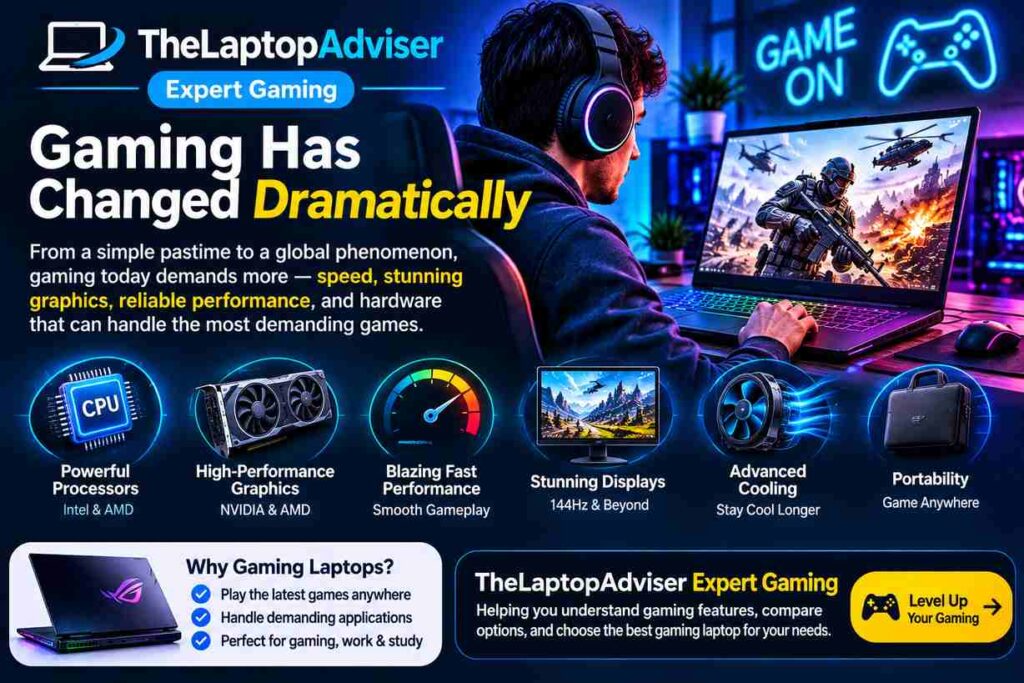
TheLaptopAdviser Expert Gaming is a keyword associated with gaming laptop information, product research, and advice for people interested in gaming computers.
The subject revolves around helping readers understand the relationship between laptop specifications and actual gaming experiences. It is not enough to look at a product advertisement and assume that a computer will perform exceptionally well simply because it has an attractive design or an impressive product name.
A gaming laptop is a specialized portable computer designed to handle graphics-intensive applications and demanding games. It usually combines a dedicated graphics processor, a capable CPU, high-speed memory, fast storage, and a cooling system designed to manage heat.
For someone researching gaming hardware, the most useful information often includes:
- Comparisons between different gaming laptop configurations.
- Explanations of processor and graphics card performance.
- Recommendations for different budgets.
- Information about screen resolution and refresh rates.
- Cooling system and temperature considerations.
- Storage and memory upgrade possibilities.
- Practical advice about gaming laptop maintenance.
The main idea is to help readers become informed buyers. After all, why spend money on features you will never use when you could invest in hardware that actually improves your gaming experience?
Understanding Its Gaming Laptop Focus
Gaming laptop advice should cover more than product specifications. It should explain how a particular configuration performs under realistic conditions.
For example, two laptops may advertise the same graphics processor but produce different results because of their power limits, cooling designs, and internal configurations.
A useful review should therefore consider the complete machine rather than focusing on one impressive component.
It should also explain the intended audience. A student who plays casual games has different requirements from a professional esports player who needs high frame rates and a responsive display.
Why Gamers Need Reliable Laptop Advice
Buying a gaming laptop can involve a considerable financial commitment. Poor decisions may result in disappointing performance, insufficient storage, uncomfortable keyboards, or unnecessary expenses.
Reliable advice helps buyers understand what they need before making a purchase.
It also encourages readers to compare independent benchmarks, manufacturer specifications, warranty conditions, and real customer experiences instead of relying exclusively on advertising.
Why Gaming Laptops Have Become So Popular
One major reason behind the popularity of gaming laptops is convenience.
Traditional gaming desktops usually require a dedicated desk, monitor, keyboard, mouse, and other accessories. A gaming laptop combines most of these essential components into one portable device.
You can use the same machine for gaming, studying, office work, programming, video editing, and entertainment.
Imagine a university student who attends classes during the day and enjoys gaming in the evening. Carrying one capable laptop is considerably more convenient than maintaining separate computers for different activities.
Another important factor is the development of portable hardware. Modern processors and graphics technologies have made it possible to deliver impressive gaming performance in relatively compact systems.
Gaming laptops also appeal to people who move frequently. Whether you travel for work, visit family, or relocate between different places, a laptop makes it easier to keep your gaming environment with you.
However, portability comes with compromises. Gaming laptops often have more limited upgrade options, smaller cooling systems, and shorter battery life during demanding gaming sessions than comparable desktop systems.
Understanding these advantages and limitations helps buyers decide whether a gaming laptop fits their lifestyle.
Understanding the Important Components of a Gaming Laptop
Before choosing a gaming laptop, you should understand the hardware that determines its performance.
A computer is like a team. Every component has a different responsibility, and the overall experience depends on how effectively those components work together.
Central Processing Unit (CPU)
The central processing unit, commonly called the CPU, is responsible for processing instructions and managing many of the calculations performed by your computer.
In gaming, the processor handles tasks such as artificial intelligence, physics calculations, background processes, and communication between different hardware components.
Modern gaming laptops commonly use processors from Intel Core and AMD Ryzen families.
When comparing CPUs, consider their generation, core count, architecture, power consumption, and performance benchmarks.
A capable processor is especially useful in strategy games, simulation titles, multiplayer environments, and situations involving streaming or multitasking.
However, a higher processor model number does not automatically mean better performance. Always compare actual specifications and independent testing.
Graphics Processing Unit (GPU)
The graphics processing unit is one of the most important components in a gaming laptop.
It handles the rendering of images, textures, lighting, shadows, and complex visual environments.
Dedicated graphics cards from NVIDIA GeForce RTX and AMD Radeon families are common in modern gaming laptops.
A powerful GPU can help deliver higher frame rates, improved graphical settings, and smoother performance in demanding games.
However, graphics performance depends on several factors beyond the GPU name.
Laptop power limits, cooling efficiency, available graphics memory, and manufacturer configuration can all influence results.
For this reason, buyers should look for benchmarks from the exact laptop model they are considering.
RAM and Storage
Random Access Memory, or RAM, temporarily stores information that applications need while running.
Insufficient memory can affect multitasking and may cause performance problems in demanding workloads.
For many modern gaming laptops, 16GB is a sensible starting point. Users who stream games, edit videos, or operate several demanding applications simultaneously may benefit from 32GB.
Storage is another important consideration.
A solid-state drive (SSD) allows your computer to access stored information quickly. It can improve startup times, application responsiveness, and game loading compared with traditional mechanical hard drives.
When choosing storage capacity, remember that modern games can occupy substantial space.
A 512GB SSD may be suitable for someone with a small collection of games, while a 1TB or larger drive can offer more convenience.
Also, check whether the laptop supports additional SSD installation or storage replacement.
Display Quality and Refresh Rate
The display is where all your gaming experiences come to life.
A laptop may contain powerful hardware, but a poor-quality screen can reduce the enjoyment of playing games.
Important display specifications include:
- Screen resolution.
- Refresh rate.
- Response time.
- Brightness.
- Color accuracy.
- Panel technology.
A 60Hz display refreshes its image up to 60 times per second. A 144Hz display can refresh up to 144 times per second.
Higher refresh rates can produce smoother motion, particularly in competitive games.
However, the GPU must generate enough frames to take advantage of a high-refresh-rate screen.
Resolution matters too. Full HD is often a practical choice for gaming performance, while QHD provides additional image detail. Higher resolutions generally demand more graphics processing power.
Battery and Power Management
Gaming laptops are designed to deliver demanding performance, but powerful hardware consumes considerable electricity.
During intensive gaming, most machines perform best when connected to their supplied power adapters.
Battery life varies depending on the processor, display, battery capacity, software settings, and workload.
If you intend to travel frequently, examine independent battery tests for ordinary productivity tasks rather than assuming advertised battery figures represent gaming performance.
Some laptops also provide performance profiles that allow users to balance speed, fan noise, and energy consumption.
How to Choose a Gaming Laptop According to Your Needs
There is no universal gaming laptop that suits every person.
The best purchasing decision begins with understanding your requirements.
Before comparing models, ask yourself three questions:
- Which games do I want to play?
- How much money can I comfortably spend?
- Will I use the laptop for activities other than gaming?
These questions can prevent unnecessary spending.
Gaming Requirements for Beginners
Beginners should focus on balanced hardware rather than expensive premium features.
If you mainly enjoy lightweight games, you may not require a high-end graphics processor.
Start by researching the minimum and recommended system requirements of your preferred games.
A modern processor, dedicated graphics where necessary, 16GB RAM, and SSD storage can provide a useful starting configuration for many gaming workloads.
Do not forget about keyboard comfort and display quality. You will interact with these components every time you use your laptop.
Gaming Requirements for Competitive Players
Competitive gaming requires particular attention to responsiveness and consistency.
Players who enjoy titles such as Valorant, Counter-Strike 2, and Fortnite may prioritize high refresh rates, stable frame rates, and low input latency.
A high-refresh-rate display can make movement appear smoother, but it is only one part of the equation.
A reliable internet connection, responsive mouse, comfortable keyboard, and properly configured graphics settings also influence competitive performance.
Gaming Requirements for Professional Users
Professional gamers, streamers, and content creators often need stronger hardware.
Running a demanding game while recording, streaming, communicating with teammates, and managing other applications creates additional workload.
In these situations, more RAM, a capable CPU, and a stronger GPU can provide meaningful benefits.
Professional users should also examine connectivity, cooling, display quality, and external monitor support.
The Importance of Graphics Performance in Modern Gaming
Graphics technology has become increasingly sophisticated.
Modern games feature detailed environments, realistic lighting, advanced shadows, complex character animations, and large open worlds.
These features require substantial processing power.
A dedicated graphics processor helps your laptop handle these visual calculations.
Two technologies worth understanding are ray tracing and AI-assisted upscaling.
Ray tracing simulates how light interacts with objects, producing realistic reflections, shadows, and illumination effects in supported games.
AI-assisted upscaling technologies can improve rendering efficiency by generating higher-resolution images from lower-resolution inputs.
However, these technologies do not provide identical benefits in every game.
Some titles benefit significantly, while others show smaller improvements.
If graphics quality is important to you, research how your preferred games perform on the laptop you intend to purchase.
Also remember that a powerful GPU does not guarantee excellent performance if the laptop has poor cooling or an inadequate processor.
Balanced hardware is essential.
Gaming Laptop Cooling Systems and Thermal Management
Heat is one of the biggest challenges facing portable gaming computers.
A processor and graphics card generate heat whenever they perform demanding calculations. During extended gaming sessions, temperatures can rise considerably.
A gaming laptop needs an effective cooling system to remove this heat.
Most modern designs use cooling fans, heat pipes, heatsinks, and strategically positioned ventilation openings.
Some premium models also use advanced thermal technologies, including vapor chambers.
When temperatures become excessive, the laptop may reduce component operating speeds to protect itself. This behavior is called thermal throttling.
It can lead to reduced frame rates and inconsistent performance.
Buyers should therefore investigate sustained temperatures and fan noise in independent reviews.
You should also understand that different laptops have different thermal limits. There is no single temperature that applies to every processor and graphics card.
A few simple habits can help maintain proper cooling:
- Place the laptop on a hard, flat surface.
- Keep ventilation openings unobstructed.
- Clean dust from the cooling system periodically.
- Avoid using the laptop on thick blankets or pillows.
- Use manufacturer-recommended performance profiles.
- Monitor temperatures when investigating performance problems.
A cooling pad may improve airflow for some designs, although its effectiveness depends on the laptop’s ventilation arrangement.
Best Gaming Laptop Features Worth Considering
Specifications are important, but they are not the only things that determine whether a laptop is enjoyable to use.
Several additional features can make a meaningful difference.
Comfortable keyboard: Look for responsive keys, sensible spacing, and a comfortable typing experience.
Reliable touchpad: Even gamers who use external mice benefit from having a responsive touchpad for everyday work.
Strong connectivity: USB ports, HDMI, USB-C, Ethernet, and wireless connectivity provide flexibility for gaming accessories.
Good audio: Clear speakers and reliable headphone support can improve entertainment and communication.
Build quality: A sturdy chassis, reliable hinges, and good keyboard construction contribute to everyday usability.
Upgrade flexibility: Replaceable memory and additional SSD slots can make future upgrades easier.
Warranty support: Check the warranty period, repair options, and availability of authorized service.
These features may not directly increase frame rates, but they can improve the complete ownership experience.
Budget Gaming Laptops: How to Get More for Your Money
A limited budget does not mean you must give up gaming.
The key is prioritizing components that matter most to your preferred games.
Start by setting a realistic spending limit. Include the cost of accessories and possible future upgrades when calculating your total budget.
Next, compare different laptop configurations.
A laptop with a midrange graphics card and balanced specifications may provide better value than a cheaper machine with an impressive processor but weak graphics.
Previous-generation models can also be worth considering.
However, compare their performance, warranty coverage, condition, and current prices against newer alternatives.
Another useful strategy is to avoid paying extra for features you do not need.
For example, an expensive RGB keyboard may look attractive, but it should not take priority over graphics performance or storage capacity.
If you mostly play esports games, a suitable midrange laptop may provide a better experience than an expensive machine designed for demanding 4K gaming.
The smartest purchase is the one that matches your requirements without stretching your budget unnecessarily.
Premium Gaming Laptops: Are They Worth the Investment?
Premium gaming laptops can offer excellent performance, advanced displays, better construction, and additional features.
They are generally designed for users who want high-end hardware and are willing to pay more for it.
Some premium models include powerful graphics processors, high-refresh-rate screens, sophisticated cooling solutions, and advanced connectivity.
However, expensive does not automatically mean better value.
Imagine spending a considerable amount on a laptop with specifications you rarely use. If you mainly play lightweight games, that additional performance may not improve your everyday experience significantly.
Premium models make more sense for people who regularly play demanding games, create professional content, stream gameplay, or need powerful hardware for other demanding applications.
Before purchasing, compare the actual performance difference between premium and midrange configurations.
Also consider weight, battery life, fan noise, warranty, and upgrade possibilities.
Gaming Laptop Performance for Popular Game Categories
Different game genres place different demands on computer hardware.
Understanding these differences can help you select a suitable laptop.
Competitive multiplayer games: These games often benefit from strong CPU performance, stable frame rates, and high-refresh-rate displays.
Open-world adventures: Large environments and detailed graphics can place considerable pressure on the GPU and available memory.
Simulation games: Complex simulations may rely heavily on CPU performance, particularly when handling large numbers of objects or characters.
Strategy games: Some strategy titles involve extensive calculations and benefit from capable processors.
Racing games: These games can benefit from strong graphics performance and responsive displays.
Casual games: Many casual titles have relatively modest requirements and can run comfortably on less expensive hardware.
Always check the requirements of the specific game rather than assuming every title in a category needs identical hardware.
Gaming Laptop vs. Gaming Desktop: Which Should You Choose?
This comparison depends largely on portability, budget, and upgrade requirements.
A gaming laptop offers convenience because its display, keyboard, speakers, and computer hardware are integrated into one machine.
A desktop generally offers more room for cooling and hardware customization.
| Feature | Gaming Laptop | Gaming Desktop |
|---|---|---|
| Portability | Highly portable | Usually stationary |
| Upgrade options | More limited | More flexible |
| Cooling capacity | Limited by compact design | Generally greater |
| Desk space | Relatively compact | Requires more space |
| Battery | Built-in battery | Usually requires external power |
| Performance value | Often more expensive for comparable hardware | Often better performance per dollar |
| Setup | Mostly integrated | Separate peripherals required |
Choose a gaming laptop if you travel, study in different locations, or need one computer for multiple environments.
Choose a desktop if you mainly game at home and want extensive upgrade flexibility.
Both can provide excellent gaming experiences when selected according to your needs.
Gaming Laptop Accessories That Improve Your Experience
A gaming laptop provides the foundation, but suitable accessories can make your setup more comfortable.
An external gaming mouse is one of the most useful additions. It can offer better control and precision than a standard touchpad.
A gaming headset provides clearer communication and helps players hear important environmental sounds.
An external keyboard may be useful for people who prefer a particular layout or mechanical switches.
Other useful accessories include:
- A sturdy laptop stand.
- An external monitor.
- A quality mouse pad.
- A suitable headset stand.
- An external SSD.
- A protective laptop bag.
- A reliable surge protector.
You do not need to purchase everything immediately.
Start with accessories that solve actual problems in your current setup.
For example, someone who plays competitive games may benefit more from a comfortable mouse than from decorative RGB accessories.
How to Maintain a Gaming Laptop for Long-Term Use
A gaming laptop is a valuable electronic device, and proper maintenance can help keep it working reliably.
Start with basic cleaning.
Dust can collect around ventilation openings and cooling fans, restricting airflow. Follow the manufacturer’s instructions when cleaning the machine.
Avoid exposing the laptop to liquids, excessive humidity, or extreme temperatures.
Software maintenance is equally important.
Install operating system updates and graphics drivers from official sources. These updates can improve compatibility, resolve bugs, and provide security improvements.
You should also monitor available storage space. Keeping some free space on your SSD can help avoid unnecessary storage problems.
Battery care deserves attention as well. If your laptop provides a battery charge-limit feature, consider using it when the computer remains connected to power for extended periods.
Finally, protect your machine when traveling.
A padded laptop bag can reduce the risk of damage caused by accidental impacts.
Small maintenance habits can make a considerable difference over time.
Common Mistakes to Avoid When Buying a Gaming Laptop
Even experienced buyers sometimes focus on the wrong specifications.
One common mistake is purchasing a laptop based only on its graphics card name. As discussed earlier, power limits and cooling can create substantial performance differences.
Another mistake is ignoring display quality.
A high-end GPU cannot compensate for a screen with poor brightness, disappointing colors, or inadequate response characteristics.
Some buyers also underestimate storage requirements. Modern games can occupy large amounts of space, and a small SSD may quickly become inconvenient.
Other mistakes include:
- Purchasing too little RAM for intended workloads.
- Ignoring warranty conditions.
- Forgetting to compare exact configurations.
- Choosing appearance over performance.
- Assuming advertised battery life represents gaming battery life.
- Buying expensive hardware without checking actual gaming requirements.
- Ignoring laptop weight and portability.
Perhaps the biggest mistake is purchasing a laptop before deciding what you need it to accomplish.
A little research beforehand can save money and prevent frustration.
Gaming Laptop Performance: Specifications vs. Real-World Experience
Specification sheets provide useful information, but they cannot explain everything about a computer.
A processor with impressive specifications may perform differently depending on its power settings and cooling conditions.
Likewise, a graphics card may produce different frame rates in different laptops.
Real-world testing is therefore essential.
When reading gaming laptop reviews, look for benchmarks involving the games you actually play.
Pay attention to average frame rates, minimum frame rates, temperatures, fan noise, and sustained performance.
Also consider whether testing was performed at the same resolution and graphics settings.
For example, comparing a laptop running a game at 1080p with another running it at 1440p does not provide a fair performance comparison.
Consistency matters.
A trustworthy comparison should explain the testing conditions instead of presenting impressive numbers without context.
The Role of Gaming Laptops in Streaming and Content Creation
Gaming laptops are no longer limited to playing games.
Many users also create videos, stream gameplay, edit photographs, develop software, and produce digital content.
This versatility makes gaming laptops attractive to students, creators, and professionals.
Streaming can place additional demands on a computer because the system must run the game while simultaneously capturing and encoding video.
A capable CPU, sufficient RAM, and supported hardware encoding features can help manage these tasks.
Video editing also benefits from strong graphics hardware, memory, and fast storage.
If you intend to use a laptop for professional creative work, examine its display quality and connectivity.
A color-accurate screen can be particularly useful for photography and video editing.
You should also consider storage expansion because high-resolution video files can consume substantial space.
A gaming laptop that balances gaming performance with productivity features can become a useful all-purpose workstation.
Future Trends in Gaming Laptop Technology
Gaming hardware continues to evolve, and future laptops will likely focus on improving performance without sacrificing portability.
One important area is graphics technology.
More efficient GPUs and advanced rendering techniques may allow laptops to deliver better visual quality while managing power consumption.
Display technology is developing too.
OLED and Mini-LED panels are becoming increasingly relevant in premium gaming systems. Depending on their implementation, these displays can offer improved contrast, color reproduction, and HDR capabilities.
Cooling systems are another area of development.
Manufacturers are exploring improved thermal designs that can manage heat more effectively within compact chassis.
Artificial intelligence is also influencing computer hardware.
AI-assisted graphics technologies can improve rendering efficiency, while other AI features may support productivity and creative applications.
Battery efficiency remains an important challenge.
Although demanding gaming still requires substantial power, improvements in processor architecture and system optimization may help laptops deliver better battery performance during everyday tasks.
Another interesting development is the growing popularity of portable gaming devices.
Traditional gaming laptops will continue to compete with handheld gaming computers and other portable systems.
For buyers, these developments create more choices.
The best approach is to purchase hardware based on current needs rather than waiting endlessly for the next generation of technology.
Conclusion
Choosing a gaming laptop is about much more than finding the most powerful graphics card or the highest processor specification. It involves understanding how different components work together and deciding which features genuinely improve your gaming experience.
TheLaptopAdviser Expert Gaming is a useful topic for people researching gaming laptop advice, performance comparisons, and buying considerations.
Throughout this guide, we have explored processors, graphics cards, RAM, storage, display quality, cooling systems, accessories, maintenance, and future developments. Each of these areas contributes to the overall performance and usability of a gaming laptop.
The most important lesson is to purchase according to your actual requirements.
A beginner may be perfectly happy with a balanced, affordable gaming machine, while a competitive player or professional creator may need stronger hardware and more advanced features.
Take time to compare configurations, investigate independent benchmarks, read warranty conditions, and consider long-term usability.
Remember, the best gaming laptop is not necessarily the most expensive model in the store. It is the one that delivers the performance, reliability, and convenience you need without wasting your money.
Frequently Asked Questions About TheLaptopAdviser Expert Gaming
1. What Is TheLaptopAdviser Expert Gaming?
TheLaptopAdviser Expert Gaming is a keyword related to gaming laptop information, buying advice, and performance discussions associated with TheLaptopAdviser. It focuses on helping readers understand gaming hardware and make informed laptop purchasing decisions.
2. What Is the Most Important Specification in a Gaming Laptop?
The graphics card is generally one of the most important specifications for modern gaming. However, the processor, RAM, cooling system, display, and graphics power configuration also influence overall performance.
3. How Much RAM Should a Gaming Laptop Have?
For many modern gaming workloads, 16GB RAM is a practical starting point. Users who stream games, edit videos, or run demanding applications alongside games may benefit from 32GB.
4. Is a Gaming Laptop Suitable for Everyday Work?
Yes. Gaming laptops can handle everyday activities such as browsing, online meetings, office applications, programming, studying, and video editing. Their powerful hardware makes them useful for more than entertainment.
5. Why Is a Dedicated Graphics Card Important?
A dedicated graphics card handles demanding visual calculations and helps games render complex environments. It can provide better gaming performance than integrated graphics, although the actual difference depends on the hardware and game.
6. Can I Upgrade the RAM and Storage in a Gaming Laptop?
Some gaming laptops support RAM and SSD upgrades, while others have partially or completely soldered memory. Always check the manufacturer’s specifications for your exact model before purchasing.
7. How Can I Prevent My Gaming Laptop From Overheating?
Use your laptop on a hard surface, keep its ventilation openings clear, clean dust regularly, and avoid unnecessary background applications. If overheating continues, have the cooling system inspected by a qualified technician.
8. Are Budget Gaming Laptops Worth Buying?
Yes. Budget gaming laptops can provide good value when their specifications match your preferred games. Compare graphics performance, processor capability, memory, display quality, and warranty before making a decision.
9. How Long Can a Gaming Laptop Last?
A gaming laptop can remain useful for several years, depending on its hardware, maintenance, usage, and changing game requirements. However, its ability to run newly released games at high settings may decrease over time.
10. Should I Buy a Gaming Laptop or a Gaming Desktop?
Choose a gaming laptop if portability and convenience matter most. A desktop is generally preferable if you want extensive upgrade options and better performance value. Your budget, gaming habits, and available space should guide the decision.