
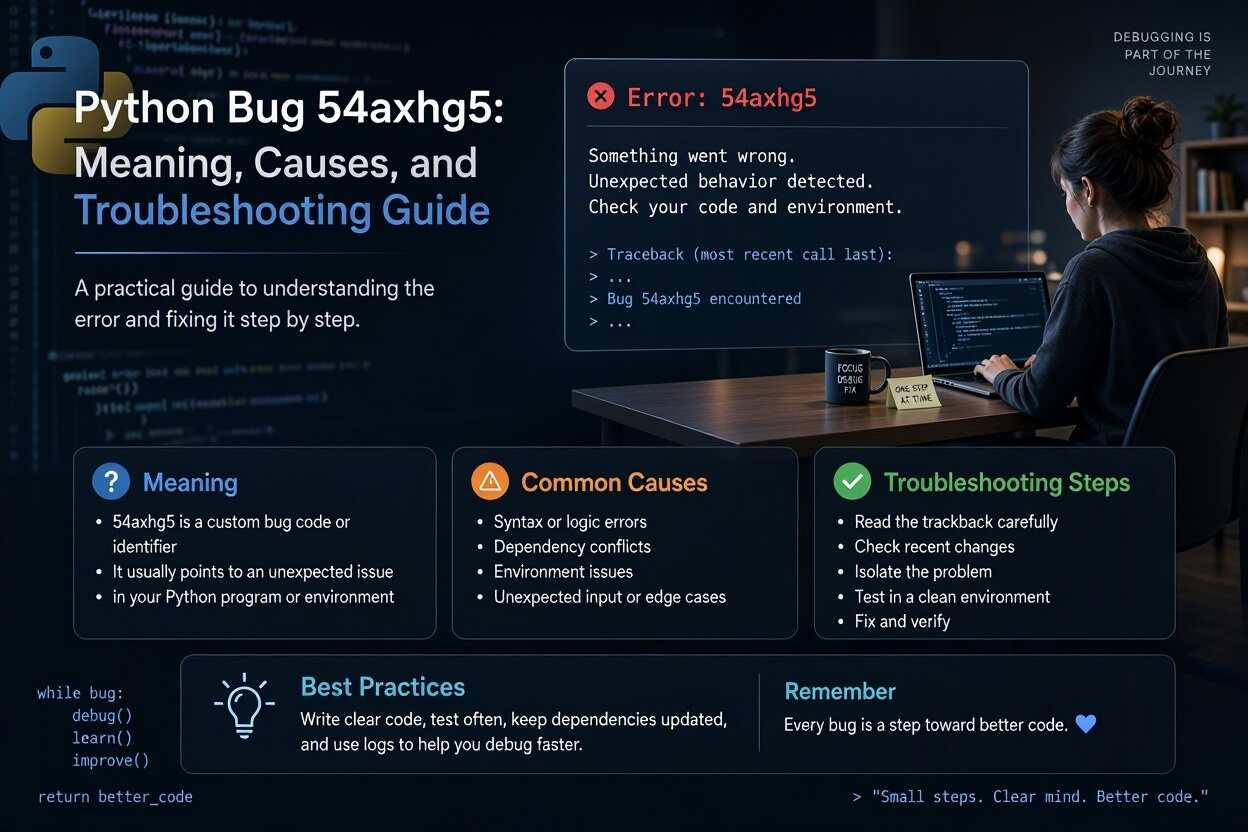
Python Bug 54axhg5: Meaning, Causes, and Troubleshooting Guide
Have you come across the term Python Bug 54axhg5 while searching for a solution to an unexpected programming problem? Perhaps you saw this unusual identifier in a log file, encountered it while running an application, or discovered it while researching Python errors online. Whatever brought you here, you probably want one thing: a clear explanation and a practical way forward.
| User’s Question / Search Intent | Helpful Answer |
|---|---|
| What is Python Bug 54axhg5? | Its exact meaning has not been verified. Identify which application or tool generated the identifier. |
| Is 54axhg5 an official Python error? | There is no verified evidence that it is an official Python exception or confirmed CPython bug identifier. |
| How do I fix Python Bug 54axhg5? | Capture the complete error message, inspect the traceback, identify the source, and check your Python environment. |
| Can my Python version cause errors? | Yes. Some applications require specific Python versions. Check compatibility before upgrading or downgrading. |
| Can missing packages cause Python errors? | Yes. Run python -m pip list to inspect installed packages in the active environment. |
| Should I reinstall Python? | Not immediately. First determine whether the problem comes from your code, dependencies, configuration, or Python installation. |
| Is Python Bug 54axhg5 malware? | The identifier alone does not establish a security threat. Investigate suspicious files or application behavior before running unknown software. |
| Where can I check for a reported Python bug? | Search the official CPython issue tracker. |
| What information is needed to diagnose the error? | The complete error message, traceback, Python version, operating system, relevant code, and steps to reproduce the problem. |
| How can I prevent similar Python errors? | Use virtual environments, document dependencies, write automated tests, maintain useful logs, and make controlled changes. |
The challenge is that not every strange-looking code represents a recognized Python error. Some identifiers belong to third-party applications, development tools, internal logs, or custom error-handling systems. Others may be incomplete references or strings that have been copied without their original context.
In this guide, we will examine what is known about Python Bug 54axhg5, explain how to investigate an unfamiliar error identifier, and walk through practical debugging techniques that work with real Python problems. You will also learn how to inspect tracebacks, check your Python environment, identify dependency issues, and determine whether a problem might be a genuine software defect.
Important: The identifier 54axhg5 has not been verified as an official Python error code or a confirmed CPython bug in the information available for this article. Rather than inventing a cause or promising a nonexistent fix, we will focus on reliable ways to identify the source of the problem.
What Is Python Bug 54axhg5?
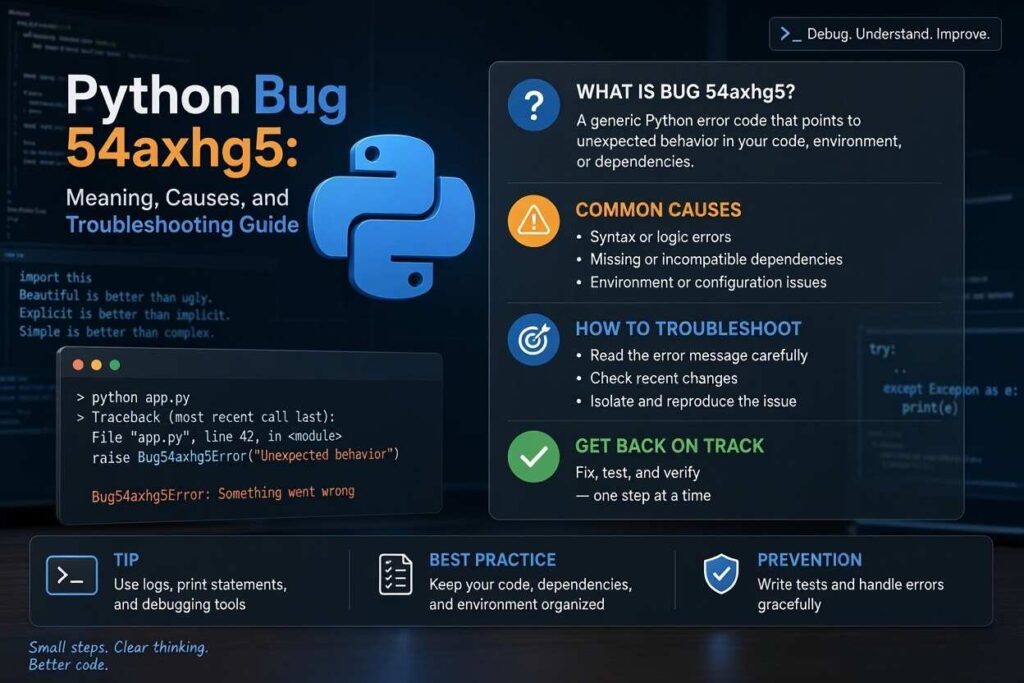
Python Bug 54axhg5 is a search phrase associated with an unfamiliar technical identifier. Without a verified report, original error message, or identifiable software source, it is not possible to say exactly what the identifier means.
Python is a widely used programming language, and its ecosystem includes thousands of libraries, frameworks, editors, automation tools, and web applications. Each component can produce different messages when something goes wrong. Consequently, an unusual string appearing in a Python-related environment does not automatically mean Python itself is responsible.
For example, an application might generate a short reference number when a request fails. A developer might attach a unique identifier to an internal exception. A website could display an abbreviated incident code that points to a server-side log. These possibilities are worth investigating, but none establishes the meaning of 54axhg5.
The first step is therefore to identify where the identifier originated.
Ask yourself three simple questions:
- Which application, script, website, or command displayed the identifier?
- Was there a longer error message next to it?
- Can you reproduce the problem by repeating the same action?
These details are far more useful than the identifier alone. Once you understand the context, you can investigate the component that actually produced the message instead of changing unrelated parts of your Python installation.
Is 54axhg5 an Official Python Error Code?
There is no verified evidence presented here that 54axhg5 is a standard Python exception or an officially documented CPython bug identifier.
Python has recognizable built-in exceptions, including TypeError, ValueError, IndexError, KeyError, and ModuleNotFoundError. These exceptions identify broad categories of problems and often include an explanation of what happened.
The string 54axhg5 does not follow the usual naming pattern of those built-in exception classes. However, this observation does not prove that the identifier is meaningless or unrelated to a Python-based application.
It could belong to a separate tool, a private issue tracker, a logging system, or a custom application. It could also be an incomplete reference that needs additional context.
If someone claims that this identifier has a specific cause or a guaranteed solution, look for supporting evidence. A credible explanation should identify the affected software, provide a reproducible example, or link to documentation or an issue report that actually discusses the same identifier.
Why the Source of an Error Identifier Matters
Imagine that your car’s dashboard displays an unfamiliar warning number. Would you immediately replace the engine? Probably not. You would first consult the manual, identify the warning, and determine which system needs attention.
Python debugging follows the same principle.
If an error comes from your code, you may need to correct a variable, function, or data structure. If it comes from a third-party library, the solution might involve a dependency update or a configuration change. If it appears on a website, the underlying issue might be on a remote server rather than your computer.
Treating every unfamiliar identifier as a Python defect can waste time and introduce new problems.
The goal is not simply to remove the error message. The goal is to understand what produced it and correct the underlying problem.
Why Are People Searching for Python Bug 54axhg5?
An unusual keyword can attract attention because it looks specific. Unlike a general search for Python debugging, a query containing a short identifier suggests that the searcher wants information about one particular problem.
Someone searching for Python Bug 54axhg5 may be trying to discover whether the code is legitimate, find an explanation, locate a fix, or determine whether it indicates a security issue.
These are reasonable questions, but search intent should not be confused with verified technical information. A phrase appearing in search results does not automatically establish that the corresponding bug exists.
There are several possible reasons someone might encounter the term.
First, the identifier may have appeared in an application log or a developer’s debugging output. Second, a third-party tool may use it as an internal reference. Third, the phrase may have been repeated in online discussions without a reliable original source.
It is also possible that a user copied the identifier incorrectly or encountered it in an environment that has not been publicly documented.
The best approach is to preserve the exact spelling, search for the surrounding message, and identify the software involved. If the identifier comes from a particular package or service, searching that product’s official documentation may produce better results than searching for the string alone.
Common Signs of an Unknown Python Error
An unfamiliar identifier can appear in several different situations. Understanding the behavior of the program can help you decide which diagnostic steps to take.
1. The Program Stops Unexpectedly
If a Python script terminates before completing its work, inspect the final lines of the traceback. An unhandled exception may reveal the immediate reason for the failure.
For instance, a program might attempt to convert invalid text into a number or access an item that does not exist. The resulting exception is more informative than a separate identifier unless that identifier is linked to a documented error report.
2. The Program Runs but Produces Incorrect Results
Not every programming problem causes a crash. Sometimes a script completes successfully but calculates the wrong answer, skips records, or produces unexpected output.
These situations require checking the logic, input data, assumptions, and intermediate results. A program can contain a logical defect without raising any exception at all.
3. The Error Appears After an Update
If the problem began after updating Python, installing a package, or changing your development environment, compare the current setup with the previous working configuration.
A dependency may have changed its behavior, a configuration file may have been overwritten, or the project may now be running under a different interpreter.
The timing provides a useful clue, but it does not prove which change caused the failure.
4. The Identifier Appears in an Application or Website
If 54axhg5 appears inside a browser, web application, or third-party program, do not assume that your local Python installation is responsible.
The application may use Python on its backend, but the visible error could originate in a remote service, database, authentication system, or another component.
Record the page or action that produced the message and check whether the service provides official troubleshooting guidance.
Potential Causes Worth Investigating
Because the meaning of Python Bug 54axhg5 remains unverified, the following possibilities are general troubleshooting leads rather than confirmed causes of this identifier.
Python Code and Logic Errors
A small mistake in program logic can create a surprisingly confusing failure. Incorrect assumptions about a list, dictionary, function argument, or return value may cause an exception or produce unexpected results.
For example, a function may expect an integer but receive a string. A loop might use an incorrect stopping condition. A program could also attempt to read a file that does not exist.
When investigating a problem, examine the line where the failure occurs and the operations immediately before it. The visible failure may be the final result of an earlier mistake.
Missing or Incompatible Dependencies
Python projects often rely on external packages. If a required package is missing, incompatible with another dependency, or installed in a different environment, the program may fail to start or behave incorrectly.
The problem can become more confusing when several Python installations exist on the same computer. You might install a package successfully but run the script using another interpreter that cannot access it.
Checking the active interpreter and package environment can help identify this type of issue.
Environment and Configuration Problems
Environment variables, file paths, permissions, credentials, and configuration settings can all affect how an application runs.
A project that works on one computer may fail on another because the second environment has different settings. Similarly, a script may stop working after a directory is renamed or a required environment variable is removed.
Before changing code, confirm that the application has access to the files, services, and settings it needs.
Third-Party Software and Custom Error Identifiers
An application built with Python can generate custom messages that are not part of Python’s built-in exception system.
A developer might create an identifier to connect a user-facing message with a server log. A framework might wrap an internal exception in its own error format. A monitoring service might assign a reference to a failed request.
If 54axhg5 is such an identifier, the relevant documentation belongs to the software that created it.
This is why identifying the source should come before trying random fixes.
How to Troubleshoot Python Bug 54axhg5 Step by Step
You do not need to be an experienced developer to begin investigating an unfamiliar error. Follow these steps carefully, changing one thing at a time.
Step 1: Capture the Complete Error Message
Start by copying the full error output. Include the lines before and after 54axhg5, the command that was running, and any traceback that appeared.
If the message came from a graphical application, take a screenshot and record the action that caused it.
Avoid sharing passwords, API keys, private tokens, or personal information contained in logs. You can replace sensitive values with placeholders while preserving the useful technical details.
A complete message provides context. A six- or seven-character identifier by itself usually does not.
Step 2: Identify the Program That Generated It
Determine whether the identifier appeared in a Python terminal, code editor, notebook, website, desktop application, or log file.
If you were running a Python script, note the command you used. For example:
python app.pyIf you were using a virtual environment, record that information too.
If the identifier appeared in a browser or another application, check the application’s support documentation before changing your Python installation.
Your objective is to establish which component produced the message, not simply which programming language the application uses.
Step 3: Check Your Python Version
Different projects support different Python releases. Confirm which interpreter is active by running:
python --versionOn systems where Python 3 is invoked separately, use:
python3 --versionYou can also inspect the executable path with:
python -c "import sys; print(sys.executable)"This command reveals the Python executable used by that particular command. It can help you identify situations where the terminal and code editor are using different interpreters.
Compare the result with your project’s documented requirements. Do not upgrade or downgrade Python without evidence that the current version is incompatible with the application.
Step 4: Inspect Installed Packages
If the problem appears to involve a library, inspect the packages installed in the active environment:
python -m pip listThe python -m pip form helps associate the package-management command with the selected Python interpreter.
If a traceback specifically names a missing module, check the package’s official installation instructions. Remember that the name used in an import statement may differ from the package name used for installation.
Avoid installing unrelated packages just because they appear in a search result for Python Bug 54axhg5. An unknown package may be unnecessary or untrustworthy.
Step 5: Reproduce the Problem
Try to repeat the same action under the same conditions.
Record the input, command, expected output, actual output, and any steps required before the error appears. If the failure occurs only occasionally, note the circumstances and frequency.
Reproducing the issue helps separate a consistent defect from an intermittent problem caused by timing, network access, external services, or changing data.
If you cannot reproduce the issue, do not assume it has been permanently fixed. Continue monitoring the relevant operation and preserve the original evidence.
Step 6: Test a Minimal Example
If the issue involves your own code, create the smallest example that demonstrates the same behavior.
Remove unrelated functions, unnecessary dependencies, and extra processing until you have a compact reproduction.
For example, if the problem occurs while accessing a list, test the list operation separately. If it occurs while importing a module, test the import in a clean environment that matches the project’s requirements.
A minimal example makes it easier to determine whether the issue belongs to your code, a package, or the environment.
Step 7: Review Recent Changes
Think about what changed shortly before the problem appeared.
You may have updated a dependency, edited a configuration file, changed a function argument, renamed a directory, or switched Python interpreters.
If your project uses version control, compare the current code with the last known working version. Review changes systematically rather than reverting everything immediately.
When practical, reproduce the issue in a separate test environment. This reduces the risk of disrupting a working application while investigating a possible cause.
Step 8: Consult Official Documentation
Once you have identified the likely component, look for reliable documentation.
For Python language errors, begin with the official tutorial on exceptions:
For a suspected defect in CPython, search the official issue tracker:
If a third-party library is involved, consult that project’s official documentation and issue tracker instead.
Search for the exact message, relevant function names, and a short description of the observed behavior. Verify that any proposed solution applies to your software version before implementing it.
Practical Python Debugging Examples
The following examples demonstrate how to diagnose real Python problems. They are illustrative debugging exercises, not verified reproductions of Python Bug 54axhg5.
Example 1: Fixing an IndexError
Consider this code:
numbers = [10, 20, 30]
print(numbers[5])
The list contains three elements, whose valid indexes are 0, 1, and 2. Requesting index 5 raises an IndexError.
One possible correction is:
numbers = [10, 20, 30]
print(numbers[2])
The lesson is straightforward: inspect the data structure and the operation that failed. Do not assume that an unrelated identifier requires reinstalling Python or modifying your system.
Example 2: Diagnosing a Missing Module
Suppose your script contains:
import requestsIf Python reports ModuleNotFoundError, the interpreter cannot locate the requested module in its current import environment.
First, verify which interpreter is running:
python -c "import sys; print(sys.executable)"Then inspect the package environment:
python -m pip show requestsIf the dependency is missing and your project requires it, follow the package’s official installation instructions in the appropriate environment.
This example shows why checking the interpreter and dependencies is more useful than guessing at the cause of an unfamiliar error code.
Example 3: Handling Unexpected Input
Suppose a program asks a user to enter a number:
age = int(input("Enter your age: "))
print(age)
If the user types a word instead of a number, Python raises a ValueError.
You can handle that situation with a try and except block:
try:
    age = int(input("Enter your age: "))
    print(age)
except ValueError:
    print("Please enter a valid whole number.")
This code handles one known failure mode and gives the user a clearer message.
However, exception handling should be specific. Catching every possible error without understanding it can conceal genuine defects and make debugging harder.
How to Determine Whether You Have Found a Genuine Python Bug
A genuine Python bug is a reproducible defect in Python’s implementation or documented behavior, rather than simply an error produced by a program written in Python.
Suppose a short script behaves differently from what the official documentation promises. You can reproduce the result using a supported Python version, and the behavior persists after ruling out your own code and external dependencies. That evidence may justify investigating a possible interpreter defect.
Before reaching that conclusion, consider the following questions:
- Does the behavior contradict the official documentation?
- Can you reproduce it using a small, self-contained example?
- Have you checked the relevant Python version?
- Have you ruled out third-party packages and environment configuration?
- Does an existing official issue describe the same behavior?
A useful investigation distinguishes confirmed facts from hypotheses. If you have not identified the source of 54axhg5, describe it as an unverified identifier rather than claiming it is a confirmed Python defect.
How to Report a Reproducible Python Bug
If your investigation suggests that Python itself contains a defect, prepare a clear report.
Start with a descriptive title that explains the unexpected behavior. Include the Python version, operating system, relevant configuration, and a minimal example that reproduces the issue.
Explain what you expected to happen and what actually happened. Include the complete traceback when relevant, but remove credentials and other confidential information.
Next, search the official CPython issue tracker to see whether someone has already reported the same problem. If an existing report matches your findings, follow its discussion and applicable contribution guidelines.
Official repository: https://github.com/python/cpython/issues
Do not report 54axhg5 as a confirmed Python bug merely because the identifier looks technical. First establish its connection to the interpreter and provide supporting evidence.
If the issue belongs to a third-party library or application, report it to that project’s maintainers instead.
Common Troubleshooting Mistakes to Avoid
Debugging becomes more effective when you avoid changes that create additional uncertainty.
Reinstalling Python immediately: Reinstallation is rarely the first step to take when the cause is unknown. It may leave the underlying code or configuration problem untouched.
Changing multiple settings simultaneously: If you change the Python version, reinstall packages, and modify your code at the same time, you may not know which change affected the outcome.
Ignoring the full traceback: A short identifier can look important while the actual exception provides the useful explanation.
Copying commands without understanding them: Commands that remove files, change permissions, install software, or modify system settings can introduce new problems.
Trusting unsupported claims: A page that promises a guaranteed fix for an undocumented identifier should provide evidence that the proposed solution addresses the same issue.
Confusing correlation with causation: If an error appeared after a software update, the update is worth investigating, but that timing alone does not prove it caused the failure.
A careful, evidence-based process is usually faster and safer than trying a long list of random fixes.
Security Precautions When Investigating Unknown Error Codes
An unfamiliar identifier does not automatically indicate malware or a security vulnerability. Nevertheless, it is sensible to take precautions when investigating unknown applications, files, and commands.
If the identifier appeared after downloading software from an unfamiliar website, verify the source before running the program again. Use official distribution channels whenever possible, and check package names carefully to avoid installing a similarly named but unrelated package.
Do not paste private authentication tokens, passwords, database credentials, or confidential logs into public forums. Redact sensitive values while retaining enough context to explain the failure.
If an application unexpectedly requests administrator access or asks you to disable security protections, stop and verify that behavior with the software provider.
For a suspicious website or application, investigate that specific product rather than assuming the identifier itself proves malicious activity.
Security decisions should be based on observable behavior and credible evidence, not on an unexplained string alone.
Best Practices for Preventing Future Python Errors
Although not every software defect can be prevented, a few consistent habits can make debugging easier and reduce avoidable failures.
Use Virtual Environments
A virtual environment helps isolate project dependencies from packages installed for other projects. This makes it easier to reproduce an application’s setup and reduces conflicts between incompatible libraries.
Keep Dependencies Documented
Record the dependencies your project needs and follow a consistent installation process. For shared projects, use the project’s existing dependency-management conventions rather than making undocumented changes.
Write Tests for Important Behavior
Automated tests help verify that a function continues to behave as expected after code changes. They can also provide small, repeatable examples when something breaks.
Use Meaningful Logging
Useful logs record relevant events and errors without exposing secrets. When appropriate, include the operation being performed and enough contextual information to connect a failure with its source.
Make Changes in Small Steps
Small, controlled changes are easier to test and reverse than large batches of unrelated modifications. Version control provides an additional safety net when troubleshooting complex problems.
Read Error Messages Carefully
Python exceptions are not merely warnings to dismiss. They often identify the operation that failed and provide a starting point for understanding why it failed.
These practices will not necessarily prevent an identifier such as 54axhg5 from appearing, but they will help you investigate its origin more efficiently.
Conclusion
Python Bug 54axhg5 is an unverified technical identifier whose exact meaning and origin have not been established in this guide. There is no reliable basis here for claiming that it represents a particular Python defect, security threat, or error with a guaranteed fix.
The best response is to investigate the context in which the identifier appeared. Capture the complete error message, identify the application responsible, check the Python version and dependency environment, reproduce the problem, and consult the appropriate official documentation.
Remember that a Python-related error does not always originate in Python itself. It may come from application logic, a third-party package, a configuration problem, or a remote service. Identifying the correct source is the key to choosing an effective solution.
With a systematic approach, you can move beyond guessing and work toward a diagnosis supported by evidence. If you have encountered 54axhg5 firsthand, the original message and the steps that produced it are the most valuable clues to investigate next.
Frequently Asked Questions (FAQs)
1. What is Python Bug 54axhg5?
Python Bug 54axhg5 is an unverified identifier that people may encounter while researching a Python-related problem. Its precise meaning has not been established here. The original error message and the software that generated it are needed to determine what it represents.
2. Is Python Bug 54axhg5 an official Python error?
There is no verified evidence presented in this article that 54axhg5 is an official Python exception or confirmed CPython bug identifier. It may be associated with another application, a custom logging system, or an undocumented source.
3. How can I fix Python Bug 54axhg5?
There is no confirmed, identifier-specific fix available in this guide. Begin by capturing the full error output, identifying the application responsible, checking the active Python environment, and consulting the relevant documentation. The correct solution depends on the actual cause.
4. Can Python Bug 54axhg5 be caused by an outdated Python version?
An outdated or incompatible Python version can cause certain applications to fail, but there is no verified evidence that this explains 54axhg5. Check your project’s supported versions before changing your installation.
5. Should I reinstall Python to fix this error?
Not as an initial troubleshooting step. First determine whether the issue originates in Python, your code, a dependency, or another application. Reinstalling Python without evidence may waste time and leave the underlying problem unresolved.
6. Is Python Bug 54axhg5 a virus or malware?
The identifier alone does not establish that a file or application is malicious. If it appeared alongside suspicious behavior, verify the application’s source, avoid running untrusted downloads, and investigate the behavior using reliable security guidance.
7. Where can I check whether Python Bug 54axhg5 has been reported?
You can search the official CPython issue tracker at https://github.com/python/cpython/issues. Search for the exact identifier and any related error message. If the issue belongs to a third-party application, check that project’s official issue tracker instead.
8. What information should I collect before asking for help?
Collect the complete error message, traceback, Python version, operating system, command used, relevant code, and steps needed to reproduce the problem. Remove passwords, tokens, and other confidential information before sharing logs publicly.
9. Can a third-party Python package generate an unfamiliar error identifier?
Yes. Applications and libraries can generate custom error messages or internal identifiers. If 54axhg5 comes from a third-party package, its documentation or maintainers may be the best source of an explanation.
10. How can I prevent similar Python debugging problems in the future?
Use virtual environments, document dependencies, write automated tests, keep useful logs, and make controlled code changes. When an error occurs, preserve the complete output and investigate its source before applying a fix. These habits make unexpected problems easier to diagnose.