Bible Quotes About Stars: Beautiful and Meaningful Scriptures
Humanity has looked up at the night sky in wonder for thousands of years, and Scripture returns to that same sky again and again as one of its richest sources of imagery.
From the stars set in place on the fourth day of creation to the star that led travelers to a manger in Bethlehem, the Bible treats the heavens as more than scenery. They are a running commentary on who God is.
The best Bible quotes about stars do more than describe a beautiful sky. They reveal a Creator who knows every star by name, who keeps covenant promises the way He kept His word to Abraham, and who is Himself described as the source of true light. Scripture ties stars to some of its most pivotal moments — the birth of Jesus, the hope of the resurrection, the future glory of God’s people — and rarely lets a reference to the heavens pass without pointing back to the One who placed them there.
This guide gathers the most meaningful Bible verses about stars, explains their biblical context, and shows what these passages teach about God’s power, His promises, and His glory. Rather than stacking verse after verse with no connective tissue, it explains why each passage matters and how it can shape prayer, reflection, and daily faith.
What Are the Best Bible Quotes About Stars?
Scripture’s references to stars rarely stop at describing the night sky. Most point past it, toward the greatness of the One who made it. Some passages emphasize God’s limitless power; others use starlight as a symbol of promise, guidance, or the coming brightness of His people.
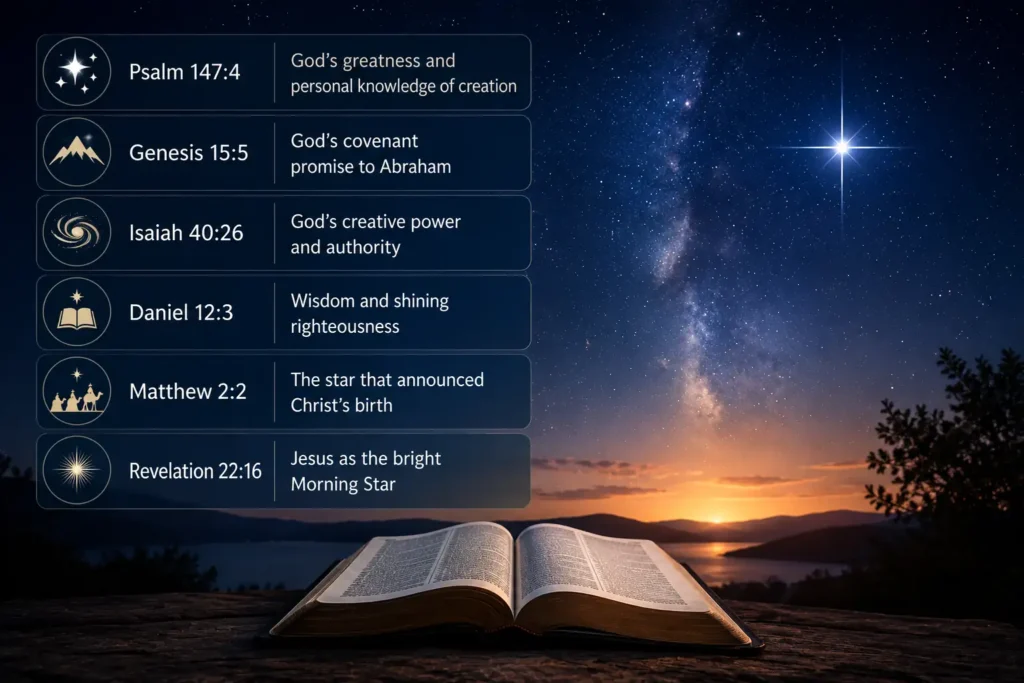
The verses below represent the major themes that run through the Bible’s treatment of stars:
| Verse | Theme |
| Psalm 147:4 | God’s greatness and personal knowledge of creation |
| Genesis 15:5 | God’s covenant promise to Abraham |
| Isaiah 40:26 | God’s creative power and authority |
| Daniel 12:3 | Wisdom and shining righteousness |
| Matthew 2:2 | The star that announced Christ’s birth |
| Revelation 22:16 | Jesus as the bright Morning Star |
Together these passages sketch a consistent picture. Stars are never presented as objects worthy of worship or as forces that shape human destiny. Genesis 15:5 uses their uncountable number as a picture of God’s ability to keep a promise that looked impossible. Isaiah 40:26 reminds a discouraged nation that the vastness of the night sky is still under God’s command. Daniel 12:3 borrows the brightness of the stars to describe the lasting reward of a faithful life.
The stars are not the point. The Creator behind them is.
Bible Quotes About Stars Revealing God’s Creation and Power
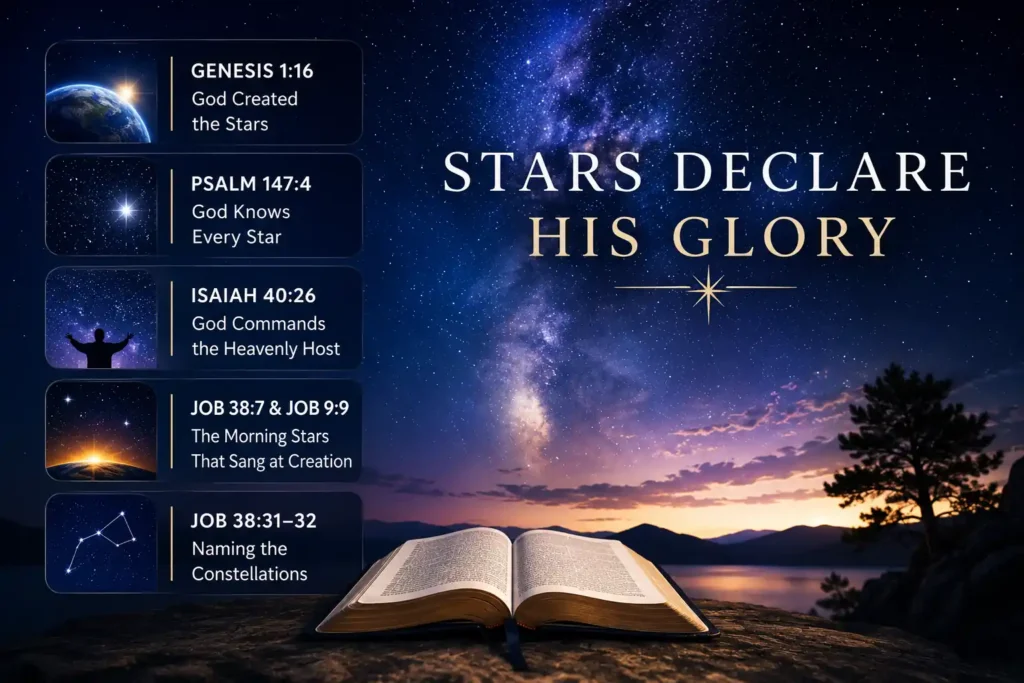
Few images in Scripture communicate God’s creative authority as clearly as the stars. Their order, scale, and beauty function as a standing witness to His wisdom, and the Bible is careful to keep that witness pointed in the right direction: not toward the stars themselves, but toward the One who set them in the sky.
Genesis 1:16 — God Created the Stars
“God made two great lights — the greater light to govern the day and the lesser light to govern the night. He also made the stars.” — Genesis 1:16
Genesis places the stars inside the ordered structure of creation, formed on the fourth day alongside the sun and moon. The verse’s brevity is deliberate. Where the surrounding ancient world often treated the sun, moon, and stars as gods in their own right, Genesis reduces them to something God made — almost an afterthought, tucked into the end of a sentence about the greater and lesser lights.
That framing carries theological weight. The same God who formed the earth also scattered the stars across the heavens, and their number does not represent something beyond His control. It reflects the scale of His work. For readers today, Genesis 1:16 turns a clear night sky into an invitation to worship rather than an invitation to wonder about astrology or cosmic fate — the stars are creations, not deities, and the text will not let them be mistaken for anything else.
Psalm 147:4 — God Knows Every Star
“He determines the number of the stars and calls them each by name.” — Psalm 147:4
This verse holds together two ideas that seem too large to fit in one sentence: a universe too vast to count, and a God who knows every part of it personally. The claim is not simply that God made something enormous. It is that nothing within that enormity escapes His attention.
The verses around Psalm 147:4 celebrate God’s care for His people — He heals the brokenhearted and gathers the outcasts in the very same psalm. That context matters. If God knows every star well enough to name it, He knows the details of an individual life just as completely. The size of the universe, in other words, is not evidence of God’s distance. It is evidence of the scale on which His attention operates.
Isaiah 40:26 — God Commands the Heavenly Host
“Lift up your eyes and look to the heavens: Who created all these? He who brings out the starry host one by one and calls forth each of them by name.” — Isaiah 40:26
Isaiah wrote to a people who needed reminding that God’s power had not diminished. He points them upward, toward a sky that looks endless and uncontrollable to any human observer, and describes God as the one who brings the stars out “one by one,” as if reviewing troops.
The message is not really about astronomy. It is about trust. A God who commands the “starry host” — a phrase used elsewhere in Scripture for armies — can also sustain His people through exile, hardship, or uncertainty. Isaiah uses the night sky to correct a small view of God: people may feel insignificant beneath a universe this large, but Scripture turns that feeling of smallness into a reason for confidence, not despair.
Job 38:7 and Job 9:9 — The Morning Stars That Sang at Creation
“While the morning stars sang together and all the angels shouted for joy?” — Job 38:7
“He is the Maker of the Bear and Orion, the Pleiades and the constellations of the south.” — Job 9:9
When God finally answers Job out of the whirlwind, He does not explain Job’s suffering. He asks questions — more than seventy of them — and several concern the stars. Job 38:7 pictures the morning stars themselves singing at creation, alongside the angels who shout for joy. It is one of the few places in Scripture where creation is not just evidence of God’s power but a participant in worship.
Job 9:9 names specific constellations — the Bear, Orion, the Pleiades — showing that the biblical writers were not vague about the night sky. They knew it well enough to name its patterns, and they used that precision to make a theological point: the same God who arranged those constellations is the one Job must ultimately answer to. The stars do not merely testify to God’s power in the abstract. They were there, according to Job, celebrating it from the beginning.
Job 38:31-32 — Naming the Constellations
“Can you bind the chains of the Pleiades, or loosen the cords of Orion? Can you bring forth the constellations in their seasons, or lead out the Bear with its cubs?” — Job 38:31-32
This is the most direct constellation reference in the Bible, and it belongs to the same speech as Job 38:7. God asks Job whether he can control the Pleiades, loosen Orion’s belt, or guide the constellations through their seasons — questions no human can answer honestly.
The Pleiades, a tight cluster of stars in the constellation Taurus, and Orion, one of the most recognizable constellations visible from earth, would have been familiar to Job’s original audience as fixed, dependable markers of the night sky. God’s questions do not ask Job to explain how these constellations work. They ask whether Job can command them — and the obvious answer restores a sense of proportion that the rest of the book of Job is built around.
How These Creation Verses Reveal God
| Biblical Theme | What Stars Reveal |
| Creation | God is the source of all things |
| Order | The universe reflects His wisdom |
| Power | God rules over what humans cannot control |
| Personal Care | The Creator of the stars also knows His people |
From this foundation — stars as evidence of a Creator who is both powerful and personally attentive — Scripture moves toward a second major theme: stars as a picture of God’s promises.
Bible Verses About Stars and God’s Promises
Stars are not only reminders of God’s creative power. They are also among Scripture’s most memorable symbols of His faithfulness. When Abraham faced deep uncertainty about his future, God did not offer him a timeline or an explanation. He pointed him toward the night sky.
Star imagery works well for this purpose because stars represent something beyond human measurement. Their number reflects abundance, and their permanence reflects reliability — qualities that make them a natural picture for a promise that outlasts a single lifetime.
Genesis 15:5 — Abraham and the Stars
“He took him outside and said, ‘Look up at the sky and count the stars — if indeed you can count them.’ Then he said to him, ‘So shall your offspring be.'” — Genesis 15:5
By the time God speaks these words, Abraham has already left his homeland and received the promise of a great nation, yet he remains childless. From a human vantage point, the promise looks stalled. God’s response is not a new explanation. It is an image: stand outside, look up, and try to count what cannot be counted.
Abraham could not calculate his future from his circumstances that night, and the passage does not pretend otherwise. What it offers instead is a picture of a promise that depends entirely on God’s character rather than on Abraham’s ability to make it happen. The stars in Genesis 15:5 come to represent three things at once — faithfulness, because the promise rests on who God is rather than what Abraham can produce; abundance, because the blessing in view is far larger than Abraham could picture; and hope that outruns present circumstances, since what looked impossible that night became, generations later, simple history.
The passage also captures something true about faith more broadly: it often has to take hold before the evidence is visible. Abraham was asked to trust a promise while looking at an empty tent and an uncertain future.
Genesis 22:17 — Descendants Like the Stars
“I will surely bless you and make your descendants as numerous as the stars in the sky and as the sand on the seashore.” — Genesis 22:17
This later chapter reaffirms the same promise with even greater force, this time pairing the stars with the sand on the seashore — two images that both represent quantities beyond human counting. The repetition across Genesis is not incidental. It shows that the star imagery given to Abraham became a settled symbol of God’s covenant, returned to again and again rather than mentioned once and dropped.
For readers today, the passage reinforces a principle that runs through the whole Abraham narrative: God’s plans are not limited by human circumstances. The same God who scattered the stars could bring about a future Abraham’s situation gave him no reason to expect.
Promise Meaning in Star Imagery
| Symbol | Meaning |
| Countless stars | God’s unlimited ability to fulfill His promises |
| Bright heavens | Hope and future blessing |
| Stars beyond counting | Blessings greater than human understanding |
| God’s covenant | His faithfulness across generations |
From Abraham’s night beneath the stars to the generations who later remembered that promise, the imagery becomes a fixed symbol of a God who keeps His word even when the timeline is unclear.
Bible Quotes About Shining Like Stars
Scripture does not stop at using stars to describe creation and covenant. It also borrows their brightness to describe wisdom, righteousness, and the influence of a life lived faithfully. This shifts the imagery from looking up at the stars to reflecting their light — believers are called not just to admire brightness but to display it.
Daniel 12:3 — The Wise Shine Like Stars
“Those who are wise will shine like the brightness of the heavens, and those who lead many to righteousness, like the stars for ever and ever.” — Daniel 12:3
This verse sits inside a passage about the future resurrection and God’s ultimate victory, describing the lasting reward given to those who pursue wisdom and lead others toward righteousness. The comparison to stars highlights two qualities at once: visibility and endurance. Stars are seen against darkness, and they keep shining long after the moment has passed.
Daniel is not suggesting that the wise become literal stars. He is using familiar imagery from creation to describe a spiritual reality — a life devoted to God can reflect that devotion in ways that outlast the person living it, which makes this one of Scripture’s more encouraging pictures of what a faithful life amounts to over time.
Philippians 2:15 — Shining in the World
“Then you will shine among them like stars in the sky.” — Philippians 2:15
Paul’s letter urges believers toward blameless, honest living precisely because that kind of life is visible — stars stand out against a dark sky for the same reason integrity stands out in a culture that often lacks it. The point is not personal recognition. It is contrast: ordinary faithfulness becomes remarkable simply by being consistent in a setting where it is rare.
Practical Application: How Believers Can Shine Like Stars
| Biblical Principle | Everyday Application |
| Live with integrity | Choose honesty when no one is watching |
| Reflect God’s character | Show kindness, patience, and compassion |
| Share truth | Encourage others with wisdom and hope |
| Remain faithful | Continue following God during difficult seasons |
Daniel 12:3 and Philippians 2:15 together show that the Bible’s star imagery is not confined to looking upward. It is also an invitation to live in a way that reflects the same light believers admire in the night sky.
Bible Verses About the Bethlehem Star and Jesus
Among all of Scripture’s star references, the Bethlehem star holds a distinct place because it is tied directly to the arrival of Jesus. Where most biblical star passages deal with creation or symbolism, the star in Matthew’s Gospel plays an active role in the story itself — guiding, announcing, and confirming.
Matthew 2:2 — The Star That Pointed to Christ
“Where is the one who has been born king of the Jews? We saw his star when it rose and have come to worship him.” — Matthew 2:2
The Magi arrive in Jerusalem searching for a newborn king, explaining that a star connected with His birth had led them there. They were not casual observers of the night sky. They read the star as a sign worth a long journey, and that journey ended at Jesus.
The star is never treated as an object of worship in its own right — its entire function is to point beyond itself. Divine guidance directed the Magi toward Jesus; the star’s rising announced that a significant king had been born; and the fact that Gentile travelers were among the first to recognize what had happened shows that this revelation reached beyond Israel from the very beginning. Shepherds received an angelic announcement; the Magi received a sign in the sky. Both paths led to the same place.
Matthew 2:10 — Joy at Seeing the Star
“When they saw the star, they were overjoyed.” — Matthew 2:10
When the star reappears partway through the Magi’s journey, their joy signals that this was never simply a navigational tool. It confirmed that they were being led somewhere specific, and their response to that confirmation was not idle admiration — they followed it to the end, presented gifts, and worshiped the child they found.
That sequence captures a principle worth carrying forward: God’s signs are meant to lead people toward Him, not to become a destination in themselves. The star did its work by delivering the Magi into the presence of Christ, and then it disappears from the narrative entirely.
Revelation 22:16 — Jesus the Morning Star
“I, Jesus, have sent my angel to give you this testimony for the churches. I am the Root and the Offspring of David, and the bright Morning Star.” — Revelation 22:16
Near the close of Scripture, Jesus applies the title “Morning Star” to Himself — a name tied to hope, victory, and the end of darkness. A morning star rises just before sunrise, signaling that night is ending. Applied to Jesus, the image points to the arrival of a new day that God’s people had been waiting for since Genesis.
A note worth making carefully: readers sometimes come across Isaiah 14:12 — rendered “Lucifer, son of the morning” in the King James Version, or “morning star, son of the dawn” in newer translations — and wonder whether it connects to Revelation 22:16. It does not describe the same figure. Isaiah 14 is a taunt against the king of Babylon, using the image of a bright star fading at sunrise as a picture of a proud ruler’s fall; many readers have long connected that fall to Satan’s own downfall, based on the language of pride and ambition in the surrounding verses. Revelation 22:16, by contrast, is Jesus speaking about Himself directly, in the book’s final chapter, with no ambiguity about who is in view. Both passages share an image — a bright object visible just before dawn — but Isaiah uses it to describe a fall, while Revelation uses it to describe a triumph. The shared title says more about the versatility of the image than about any relationship between the two figures.
Jesus and Star Symbolism in the Bible
| Star Reference | Meaning | Biblical Focus |
| Bethlehem star | Guidance toward Christ | Matthew 2 |
| Morning Star (Jesus) | Hope and salvation | Revelation 22:16 |
| Morning star (Babylon’s king) | A proud ruler’s fall | Isaiah 14:12 |
| Stars in creation | God’s power and wisdom | Genesis 1:16 |
| Stars of promise | God’s faithfulness | Genesis 15:5 |
From the star Abraham saw over an empty desert to the one that announced Christ’s birth, Scripture’s star imagery consistently points toward the same conclusion: God’s promises unfold on His timing, and He gives visible signs along the way.
Bible Verses About Stars in Prophecy
Some of the Bible’s more difficult star references appear in prophecy. Unlike the creation passages, where stars refer to actual heavenly bodies, prophetic texts often use cosmic language to describe major events, coming judgment, or a shift in God’s dealings with the world — and reading them well means paying attention to genre, not just vocabulary.
Falling Stars in Biblical Prophecy
“The stars will fall from the sky, and the heavenly bodies will be shaken.” — Matthew 24:29
Jesus describes this alongside a darkened sun and a moon that gives no light, all within a larger discussion about events tied to His return. Dramatic language about the heavens shifting is a recurring device in prophetic literature, used to communicate the seriousness of what is being described rather than to offer a literal astronomical forecast.
That does not mean every prophetic reference to the sky should be read symbolically by default, but it does mean the surrounding literary context has to guide the interpretation. The consistent thread is that creation itself remains under God’s authority — the same God who set the stars in place can use the language of their falling to describe His future action.
Stars in Revelation
Revelation returns to star imagery repeatedly, almost always symbolically. Revelation 1:16 describes Jesus holding seven stars in His right hand, and Revelation 1:20 explains what they mean: the seven stars represent the angels, or messengers, of the seven churches addressed earlier in the book.
That explanation matters for reading the rest of Revelation’s star references. A star in Scripture does not carry one fixed meaning — sometimes it refers to an actual part of creation, and sometimes it stands for a person, a spiritual reality, or a prophetic symbol, and the immediate context is what settles which is intended.
Literal and Symbolic Star References in the Bible
| Passage | Type | Meaning |
| Genesis 1:16 | Literal creation | God created the stars |
| Genesis 15:5 | Symbolic promise | Abraham’s descendants |
| Job 38:31-32 | Literal creation | Named constellations |
| Matthew 24:29 | Prophetic imagery | Cosmic signs connected with future events |
| Revelation 1:16 | Symbolic vision | Seven stars representing heavenly messengers |
| Revelation 22:16 | Spiritual title | Jesus as the Morning Star |
Reading these passages with their context in view keeps the central message clear. Whether literal or symbolic, the stars in prophecy point back to the same authority behind the stars in Genesis — God’s plan unfolding on His terms.
What Do Stars Symbolize in the Bible?
Across Scripture, stars carry meaning that goes well beyond their physical beauty. They represent God’s creative power, His covenant faithfulness, spiritual wisdom, and — in a handful of passages — the person of Christ Himself. Part of what makes them such effective symbols is their place in ordinary human experience: countless, distant, brilliant, and entirely outside human control. Those same qualities made them natural pictures for truths that are otherwise hard to put into words.
Scripture never treats stars as objects of worship or forces that determine human fate. They consistently point back to God as Creator and ruler over everything they represent.
| Symbol | Meaning |
| Creation | God’s power and authority over the universe |
| Promise | God’s faithfulness and ability to fulfill His word |
| Light | Wisdom and righteous living |
| Guidance | God’s direction and revelation |
| Glory | Christ as the ultimate source of spiritual light |
Why God Uses Stars as Imagery
Ancient audiences, looking into a sky unclouded by artificial light, saw thousands of stars scattered overhead — vast, ordered, and entirely beyond their reach. Scripture draws on exactly those qualities.
Countless number. When God told Abraham his descendants would outnumber the stars, the image communicated an abundance no one could calculate. Abraham could not count the stars any more than he could work out how the promise would be fulfilled, and that gap between what he could see and what God had promised became the whole point.
Brightness. Stars represent light shining against darkness, an image behind both Daniel 12:3 and Philippians 2:15. A life shaped by God’s character can stand out the same way a star stands out once the sky goes dark — not by force, but simply by being visible where little else is.
Heavenly position. Because stars sit beyond ordinary reach, Scripture often uses them to redirect attention from earthly concerns toward God’s greatness. Psalm 19:1 captures this directly: “The heavens declare the glory of God; the skies proclaim the work of his hands.” Psalm 8:3-4 goes further, describing the sense of wonder that comes from considering the heavens — a wonder that leads not to despair at human smallness but to amazement that God still cares.
The biblical meaning of stars can be summarized in a single idea: they reveal the greatness of God while pointing toward His promises, His guidance, and His presence.
Bible Quotes About Stars (KJV)
Many readers search specifically for the King James Version’s rendering of these passages, drawn to its traditional cadence and its long history in Christian devotion and worship. Reading them well, though, still depends on understanding the context behind the words rather than the wording alone.
Genesis 15:5 KJV — Stars as a Picture of God’s Promise
“And he brought him forth abroad, and said, Look now toward heaven, and tell the stars, if thou be able to number them: and he said unto him, So shall thy seed be.” — Genesis 15:5 KJV
This remains one of the most recognizable star passages in the Bible. For readers of the King James text, its power comes from linking the beauty of the night sky directly to the reliability of God’s word.
Psalm 147:4 KJV — Stars Under God’s Authority
“He telleth the number of the stars; he calleth them all by their names.” — Psalm 147:4 KJV
The verse’s older phrasing sharpens a contrast that runs through the whole psalm: the enormous scale of the heavens set against the personal, almost intimate, care God shows His people.
Daniel 12:3 KJV — Shining Like Stars
“And they that be wise shall shine as the brightness of the firmament; and they that turn many to righteousness as the stars for ever and ever.” — Daniel 12:3 KJV
Here the image is not physical transformation but lasting impact — the enduring influence of a life spent turning others toward righteousness.
For many readers, these three verses combine memorable language with some of the Bible’s deepest themes: God’s promises, His greatness, and the calling to live faithfully in light of both.
Bible Verses About Stars for Every Situation
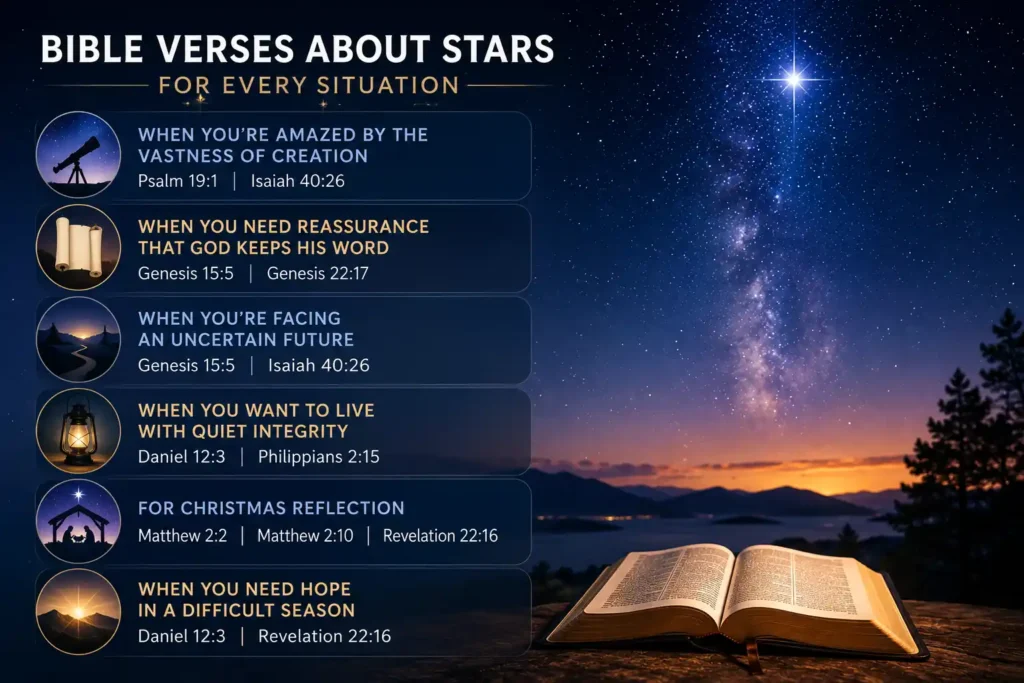
Readers often come to this topic looking for more than a reference list — they want a verse that fits where they are. The passages below are grouped by the need they speak to most directly.
When you’re amazed by the vastness of creation: Psalm 19:1 and Isaiah 40:26 both turn wonder at the night sky into worship, reframing the size of the universe as evidence of God’s greatness rather than a reason to feel small.
When you need reassurance that God keeps His word: Genesis 15:5 and Genesis 22:17 root that reassurance in Abraham’s story — a promise that looked impossible from the ground and became history over time.
When you’re facing an uncertain future: Genesis 15:5 works here as well, since Abraham received this promise while still waiting on it. Isaiah 40:26 adds that the same God who commands the stars has strength to sustain those who feel weary.
When you want to live with quiet integrity: Daniel 12:3 and Philippians 2:15 both use starlight as a picture of a faithful life that stands out simply by being consistent.
For Christmas reflection: Matthew 2:2 and Matthew 2:10 return attention to the star that led travelers to Christ, and Revelation 22:16 completes the picture by naming Jesus Himself as the Morning Star the Bethlehem star only pointed toward.
When you need hope in a difficult season: Daniel 12:3’s promise of lasting brightness and Revelation 22:16’s image of a new dawn both speak to circumstances that feel dark in the moment but are not the final word.
What Is the Best Bible Verse About Stars?
There is no single verse that outranks every other for every reader, but a few stand out for particular purposes. For the most complete picture of God’s promise-keeping character, Genesis 15:5 is difficult to beat — it is the passage most other star verses in the Bible ultimately build on. For sheer expression of God’s greatness, Isaiah 40:26 combines poetic language with a direct theological claim in a way few other passages manage. And for a verse that captures both parts of the Bible’s star imagery at once — a physical star and a spiritual title — Revelation 22:16 closes the loop that begins with the star over Bethlehem.
Frequently Asked Questions About Stars in the Bible
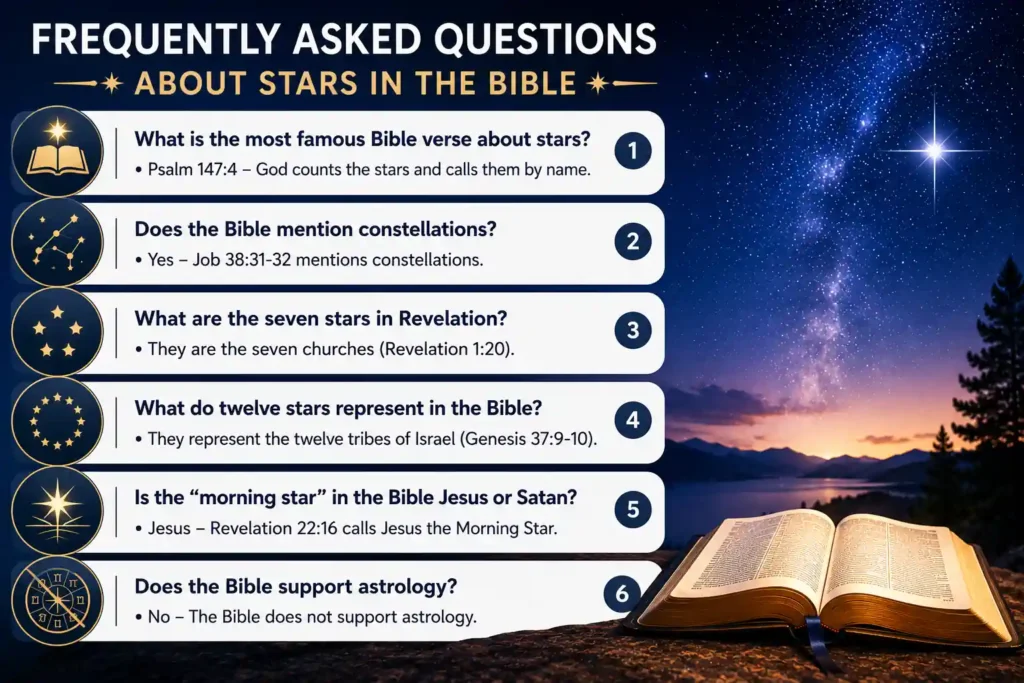
What is the most famous Bible verse about stars?
Genesis 15:5 is among the most famous, recording the moment God tells Abraham to look at the stars and promises that his descendants will be just as numerous. Its fame comes from tying a vivid image directly to God’s covenant faithfulness. Psalm 147:4, Isaiah 40:26, Daniel 12:3, and Matthew 2:2 are also widely quoted.
Does the Bible mention constellations?
Yes. Job 38:31-32 names the Pleiades and Orion directly, asking whether Job can bind or loosen them, and Job 9:9 credits God as the maker of “the Bear and Orion, the Pleiades and the constellations of the south.” These references affirm God’s authority over creation — they are not an endorsement of astrology.
What are the seven stars in Revelation?
Revelation 1:16 describes Jesus holding seven stars in His right hand, and Revelation 1:20 explains that they represent the angels, or messengers, of the seven churches addressed in the book’s opening chapters. The image is symbolic rather than a reference to actual astronomical stars.
What do twelve stars represent in the Bible?
Twelve stars appear in two notable places. Genesis 37:9 describes Joseph’s dream, in which eleven stars bow to him alongside the sun and moon, representing his family. Revelation 12:1 describes a woman wearing a crown of twelve stars, an image many interpreters connect to God’s people and the twelve tribes of Israel. The precise meaning depends on the passage and its surrounding context.
Is the “morning star” in the Bible Jesus or Satan?
Both titles appear, but they refer to different figures in different contexts. Isaiah 14:12 uses “morning star” (rendered “Lucifer” in the KJV) as part of a taunt against the king of Babylon, language many readers connect to Satan’s fall from pride. Revelation 22:16 has Jesus applying the same title to Himself directly, with no ambiguity about who is speaking. The shared image — a bright light visible before dawn — is used for opposite purposes: one describes a fall, the other a triumph.
Does the Bible support astrology?
No. Scripture consistently presents stars as part of God’s creation, used to display His power, His promises, and His purposes — never as forces that determine personality, decisions, or the future. Deuteronomy 4:19 specifically warns against being drawn into worshiping the sun, moon, and stars, redirecting worship back to the God who made them.
Conclusion
Scripture’s references to stars point in one consistent direction: past the beauty of the night sky and toward the Creator who filled it. Stars display God’s power in Genesis and Job, mark His promises to Abraham, describe the reward of a wise and faithful life, and announce the arrival of Jesus. Even in prophecy, where the imagery grows more difficult, the stars remain under the same authority that placed them in the sky to begin with.
From Abraham counting what could not be counted to the Bethlehem star resting over a manger, the Bible keeps returning to the heavens to say the same thing in different ways: God keeps His word, and He is not finished. The ultimate focus was never the stars themselves, but the hope found in Jesus Christ — the Morning Star the Bethlehem star was always pointing toward.